Friday, October 27, 2017

Back Home Again in Indiana

When our family first moved to Indianapolis back in 1951 when Dad started working for Eli Lilly, we first lived in a rented duplex at 3025 N. Delaware Street.  My memory says it was a large duplex with a big, fenced back yard with an alley behind it for garbage collection. 

Today, on a nostalgic trip back through time to revisit our old homes, I find that my memory was perhaps playing tricks on me.  The large duplex, which we called a 'double' was quite a bit smaller than the other old homes on the street.  I remember a sidewalk in front of the house, with a another sidewalk leading from the main sidewalk up to our porch.  I remember that small sidewalk having a couple of steps up from the street where I sat and played with worms sometimes.  Today there was no sidewalk leading up to the house, although I guess that could have disappeared over the years.  There were only some small stepping stones. 

When I lived there, the Oborn family lived in the adjoining duplex.  Now the neighbors tell us the other side is occupied by the son of the current owner.  The fenced back yard is no longer fenced, and it appears a garage might have been back there at one time, but only a bit of the foundation is left.  The alley is much the same as I remember.

The most astonishing thing about the current house is the trees.  On the other side, a large branch of a tree appears as though it rests on the roof.  According to the neighbors, a large storm a few weeks ago was responsible for the demise of the large tree branch which now blocks the rear door of our side.  The building is not nearly as large as I remembered.  The large yard is clearly also not large.


House front.  We lived on the right side which is currently for rent.  You can see the stepping stones if you look closely.


House back with large tree limb blocking rear door on our side.  The remains of a garage foundation are visible.


When I was about four, my parents were prepared to buy their first home which was quite an exciting day for our family although I recall feeling sad and knowing I'd miss the place.  Our next home was at 3449 N. Adams Street.  This house also had a large backyard where I could play.  We even got a dog which we named Candy.  It was a nice house, just right for our family of three.  It had a kitchen, living room, dining room, bathroom and two bedrooms upstairs and a mostly unfinished basement except for one room finished in knotty pine panels.  The house was at the end of a dead end road then.  We had neighbors on one side and the other side went down into a little ravine where we had a little garden.  I could walk around the edge of the ravine to get to the next street over, which was a through street, so I could get to school.   We had happy times in that house.  After a time I got a brother!  Because he was small, he got my upstairs bedroom and I had the lovely knotty pine room in the basement.  The basement  also included a coal room and a furnace room.  The washing machine was also in the basement.  Eventually we knew it was time to leave the little house because I got a new sister and the house was getting crowded.


House front.  Living room to the left and bedroom to the right.


House back:  Bedroom to the left and kitchen door to the right leading to a small patio.  Coal was brought to the rear of the house and delivered right into the coal room until the house was converted to oil heat.


Back yard looking from the house to the ravine. 

I think there was no carport when we lived in the house.  The large back yard was not as large as I recalled.  The back fence was gone and the overgrown brush possibly made it seem smaller.  Sadly, the house was empty and appeared to be abandoned.  The front door was padlocked, but a look through the windows confirmed it was empty.  Broken glass and empty liquor bottles were evident all around the home.  I was sad to see the disrepair.

I suppose it was around 1956 or 1957 when my parents realized we needed to move to have more space, so they began looking for a new place.  They found one, but the home was not finished.  They must have agreed to finish the house as part of the deal, because we spent many hours there finishing and painting walls and other finishing work on the house.  I think it must have been about March of 1957 when we finally moved in to 5010 Glenmar Lane.

It was called a tri-level house.  A hallway bisected the house from front door to back door.  To the left of the front door was a living room with dining room and kitchen behind it, all on the middle level.  To the right of the front door and the hallway was a small stairway that led up to three bedrooms.  A larger stairway led to the basement level beneath the bedrooms which became our family room, laundry and food storage area. It was also on a dead end street.  Until more houses were built at the end of the street, we could pick wild strawberries there.  We had a nice garden area behind the house.  There was a medium sized Sycamore tree in the front yard.  We also had a pretty redbud tree.  We children spend a good bit of time picking up rocks in the yard before a lawn could be planted.  The driveway had a turnout with a large wild cherry tree next to it that we liked to climb.  At first the driveway was gravel, but later it was paved with 'blacktop'.   Another sister was born while we lived there so us three girls shared a room.
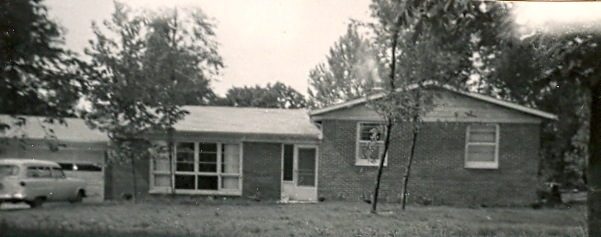


All of the trees I remembered are gone now and part of the garage is obscured by a large bush that I don't recall having.  Otherwise, it looked pretty much the same, although the blacktop appears to have reverted to gravel.  The large window in the middle was our living room.  The bedroom upstairs on the right was mine and my sisters' and the one on the left belonged to my brother.

It was when I was about 12 that my family once again decided we needed more space, so again my parents started looking for another place.  This time they found a new subdivision where they could choose their own lot and house plan, but the house was not quite finished when we had to move out of our other home, so the builder offered to finish the garage first and put a lock on it, so we moved all our belongings into the garage and then went on vacation to visit our grandparents.  When we returned home, the house was finished enough to move in to.  There were still a few remaining things to do, so it seemed we always had members of various building trades around for a few weeks until everything was completed.   What luxury!  I had my own room!  My brother had his own room as well and my sisters shared the fourth bedroom.    It was pretty much a new neighborhood, so most of the trees had been removed by the subdivider to make it easier for him.  Trees in the neighborhood were all small ones planted by the home owners.  We lived at 5464 Mark Lane.


Over the years, the neighborhood has become shady and full of lovely trees.  It is still a well-kept neighborhood.   I lived in this home during grades 8-12, after which I moved away for college and really never lived at home again for any great length of time.

A few years later, my family moved to their last Indianapolis home at 6637 Albion Drive.  This home still appears to be in good repair.


In late 1984 or early 1985, our family's time in Indiana ended as Dad retired and they moved on to the next part of their lives, but we'll always remember the song we learned to sing there:

Back Home Again in Indiana

Back home again in Indiana,
And it seems that I can see
The gleaming candle light, still burning bright,
Through the Sycamores for me.
The new-mown hay sends all its fragnance
Through the fields I used to roam.
When I dream about the moonlight on the Wabash
Then I long for my Indiana home.


Saturday, October 21, 2017

The Spelling Bee


It's amazing what one can find while cleaning out cupboards.  The following story was written by a 6th grade guest blogger many years ago.

"In March of 1985, when I was in 6th grade at Snowshoe Elementary,  our school had two spelling bees.  The first one was to see who would represent our school in the District Spelling Bee.  We got to send two 4th graders, two 5th graders and two 6th graders.  I got 2nd place for the 6th grade, so I got to go to the district contest. Then we had to compete in the District Spelling Bee.  It was held at Wasilla Junior High.  It was during the school day, so I got to miss school to go to it.  I was really nervous when I had to spell.  They did the 4th grade contest first.  One of the kids from Snowshoe won 1st place.  Then they did the 5th grade contest.  Another kid from Snowshoe took 1st place.  Mrs. Rolstad, the Snowshoe librarian, called Mr. Seims (the principal) to tell him the good news.  Then it was time for the 6th grade contest!  I was really excited when I won!  Mrs. Rolstad called Mr. Seims again to tell him that Snowshoe won all three contests!  He announced the good news to the whole school over the PA system.  I got a trophy, a blue ribbon and a new dictionary for being the best 6th grade speller in the District.


After I won the 6th grade contest, my classmates made a gigantic poster for me.  I was really proud.

At Snowshoe we also had another spelling bee to see who would represent our school in the Alaska State Spelling Bee in Anchorage.  All the 4th, 5th and 6th graders who wished to compete were there.  That was a lot of kids!  After quite awhile, I was the only one left!  When I realized that I had won, my legs got so quivery that I could hardly walk.  I got to miss another day of school to compete in the State Spelling Bee.  Mom and Dad took me to Anchorage for that.  It lasted two days.  I got through the first day okay.  One of the words I had to spell was 'astringe'.  The second day I had to spell 'hygienist'.  Then I got a word I never heard of.  I think it was 'viuva'.  It was supposed to be some kind of southern California rockfish.  I missed on that one.  Still, I got through four rounds.  Some of the prizes I got were  a frisbee, a 6-pack of Slice, a hat, a t-shirt, and coupons for ice cream and a doughnut.  I came in 77th out of 216 contestants."


Note:  There was also a lovely form letter from the lieutenant governor.  We found it entertaining that Blaine's name was spelled incorrectly on it.


Friday, September 22, 2017

Bees


   The first “bee” I remember meeting was when I was pretty young.  It apparently was not happy to meet me and showed its displeasure by stinging me.  My mother called it a sweat bee and told me if I didn’t bother it, it would not bother me.  After that I made it a point to give them a wide berth and all was well.


   My youngest brother, Duane, was not as willing to leave them alone.  When he was about five, a young man who visited the house showed off his favorite trick — sneaking up on a honey bee and grabbing it by the wings so he could look at it without getting stung.  Duane could hardly wait to try it.  It wasn’t long before he came into the house crying that he had been stung.  “Were you bothering the bees?” Mom asked.
    “No!  I was only going to pick it  up by its wings,”  he answered.
    “Well don’t try to hold the bees!”
    “OK” he answered, as he went back out to play.
    Five minutes later he was back in the house, howling that a bee had stung him. “Did you bother the bees?  I told you to leave them alone!” my mother said.
    “I didn’t try to pick up the bee,” my affronted brother answered.  “I only kicked it with my foot.”
    That was pretty much my whole interaction with bees until I was an adult…an adult with a spouse who decided to become a beekeeper.  I soon became a bit more knowledgable about what a bee was.  Honey bees are a thing not to be confused with bumble bees, wasps, hornets, yellow jackets or various other stinging insects.  Some varieties of honey bee are more aggressive than others. Before I knew it we were the owners of 20 hives of bees.


    When Roger worked with the bees, he usually wore his bee suit for protection but sometimes the bees just didn’t seem to care that we were around.  If he needed to pull honey frames out of the hives, he usually used his smoker on the bees which made them pretty docile.
    Because we lived in Alaska, bees didn’t overwinter very well, so every Spring we received screen covered boxes of bees with a special container for the queen bee inside.  Roger worked at the main post office in Anchorage at the time and soon became known as the man to contact if there was a bee problem.  More than once he made the hour-long drive home with boxes of bees, always with a few loose ones crawling around on the back window.  He sometimes got strange looks from passing motorists.
    In spite of wearing a bee suit, stings were not uncommon.  It seemed like he almost became immune to the stings after a while and would not react as strongly as he did at first.
   Sometimes when the hives got too crowded, the bees would swarm and try to go off to make a new colony.  Then he would put another super on the hive with new frames for the bees to fill, or start a new hive.
    The bees feasted all of the short Alaskan summer on fireweed which made a wonderful, light honey.  In the Fall, because they could not overwinter, he’d vacuum the bees up into his shop vac.  One year he decided all those little bee bodies would be good fertilizer for our greenhouse, so he dumped them all in there.  Who knew that that many dead bees could stink so bad or be potent enough to kill the tomato plants?
    With the bees gone, we could pull out the frames of honey.  With a heated knife we skimmed off the wax on the top surface of the honey combs and then placed the frames, two at a time, in the extractor.  The children loved to help spin the extractor which made the honey come out of the combs with centrifugal force.  At the bottom of the extractor was a spigot where the honey came out. 
    Mostly the children stayed clear of the area around the hives but Blaine did get stung at least once.  Shortly after, I noticed he had a large, hard lump on his head (not where he had been stung).  The doctor explained that it was a very swollen lymph node clearing the bee venom from his system.
    Eventually we had to give up raising bees, not because of allergies to bee stings. but because Roger became allergic to all the pollen stored in the hives along with the honey.


     One day at school, one of the teachers was reading a book to his class.  It was called  “A Taste of Blackberries” by Doris Buchanan Smith. It told of a young boy who was apparently highly allergic to bee stings and the impact his story had on his friends when he died as a result of a sting.  It had never before crossed my mind that a bee sting could be any more than a painful inconvenience.  I have heard many people since then say they are allergic to bee stings, but most of them are not.  Everyone reacts with a painful, red area around the sting, but some have far more serious reactions.
    Our youngest daughter was stung several times and reacted stronger than most people.  On her the red area around the sting would grow quite large.  At Girls Camp one year, she was stung.  The nurse was concerned about how large the reddened area was becoming, so used a red pen to mark the edges of the red area so she could tell how much it was growing.  She was concerned about possible cellulitus. Another sting a few years later reacted worse.  The doctor advised us to keep Zyrtec or Benedryl on hand to treat her if she was stung again. In retrospect I think perhaps her mild allergy was likely one of those tender mercies as you will see later.
    After we moved to Utah, through the wonders of Facebook, I was introduced to a man named Gerd Meyer.  Gerd lived in Wechold, Germany, a small town that also happens to be the ancestral home of Roger’s maternal ancestors.  The local church books cannot be filmed, so doing genealogy in that area of the world was difficult.  Gerd was a retired scientist who developed an interest in genealogy and village history after his retirement.  He led a Facebook group devoted to helping people with their ancestral roots in that town.  Eventually Gerd asked his good friend, Matthias Steinke, to co-administer the group. Together they were so helpful in making genealogical connections.  It was in August of 2016 that Matthias posted a sad message to the group.  Gerd had been helping his daughter remove a bush from her yard when he was attacked by a swarm of wasps living under the bush. He was stung several times and quickly became unconscious and died soon after.
     In the mean while, our daughter who is mildly allergic to bee venom, grew up, married and became a mother to two little girls.  They are of the urban homestead persuasion, so like to do things to be a little more self sufficient.  So it is that our son-in-law decided keeping bees would be a fun hobby.  Because of her previous mild allergic reactions, they took the precaution of getting her an epipen in case she needed it. 
    They kept bees for a couple of years before moving to this area.  Even their little girl had her own bee suit and enjoyed helping her dad check on the bees.


    After a time, the family moved near our area and the bees even came to live in our yard while a new fence was being constructed at their house…much to the consternation of some of our neighbors, I believe. We enjoyed watching the battles between the bees and the yellow jackets and were happy to see that the bees won by the piles of dead yellow jackets outside the hives. Sadly after quite a hard winter, the bees didn’t make it, so when Spring came, they ordered new bees to start a new colony in their backyard. During the process of introducing the bees into their new home, a couple of the ungrateful little creatures stung our son-in-law.  That was not particularly unusual as he’d been stung before with no problem.  While he was working with the bees, the 5 year old was playing in another part of the back yard.  Daughter was showering the 3 year old who had somehow gotten into the mud, when son-in-law came into the house rather agitated.  He suddenly was having trouble breathing and was turning red all over.  Bee allergy!  This is where the tender mercies come in.  I think daughter’s experiences from years past were in preparation for this exact thing.  She grabbed her epipen and they used it on her husband before bundling  3 year old into pajamas and handing her to a neighbor along with asking the neighbor to find the 5 year old playing in the back yard.  Then they left for the ER, where they gave him the equivalent of another epipen.  He was there for a number of hours before he was deemed to be out of danger from his anaphylactic reaction.
    After they called us from the hospital, we went to pick up the children and bring them to our house.  The wide open garage door and the front door standing open testified to their hurry to get to the hospital.  Fortunately son in law survived.  He was advised to call 911 if it ever happens again.
    Bees obviously have their good points and maybe a few bad points, but usually they are worthwhile for the delicious honey they provide.  For most folks it is worth the risk.

Saturday, June 10, 2017

Building a Shave Horse

For years I’ve been planning to build a shave horse.  It is a foot operated vise that makes wood carving much easier for traditional woodworkers. We need one in the Woodwright shop.  I also wanted to make one so I can say that I did. For several years I had a nice piece of dried walnut sitting in my workshop. Never could I think of anything to do with it. Suddenly out of the ether came an idea. Make a shave horse out of  it!

I called a friend of mine who has a TimberKing bandsaw designed to make planks out of logs. He invited me to come over and he would cut the wood into planks.


After cutting the old log into planks I outlined the pieces I needed to cut out to make the shavehorse.  


Using a tablesaw and a bandsaw, with the assistance of a son-in-law, I cut out the pieces. 


I had previously reduced them to the  right thickness with a planer and finished them with a sander. I know this coveted item is made for using traditional hand tools, but there is nothing that says you cannot use power tools to make it.

Next I cut out the hole the foot lever would fit through. Not too difficult of a job.
The angled wood ramp followed.


Next sub-routine was to make the legs on my 1880’s lathe. I discovered the 1946 electric motor is failing and needs to be replaced in the near future. It had enough life in it to finish the job, fortunately.


I made a jig in order to drill the holes at the correct angle for the splayed legs. This part actually went smoothly, much to my surprise and delight. I glued and wedged the legs into the drilled holes. Perfect fit! A small miracle.


The installation of the angled ramp went well. It is held into place with carriage bolts. It was followed up by the installation of the foot lever. Everything fit and worked smoothly. 


Now I disassembled the shavehorse and put finish on it. I used tung oil. Two coats well applied and allowed to dry. 


After the finish dried I reassembled the shave horse. Everything still worked.


Upon completion I took it out to the Woodwright shop at the American West Heritage Center. It has been put to use in the manufacture of spoons and other kitchen products. It also serves as a training aid for people interested in traditional woodworking. 


A rewarding experience. Come and visit it sometime.

Thursday, June 8, 2017

A Trip Down Memory Lane - Box Elder County Schools

I have been reading for some time of a temporary exhibit in the Brigham City Museum about the history of the schools in what is now Box Elder County.  I thought Mom might enjoy it since she is a product of those schools, so we set off on a Tuesday afternoon to see the exhibit before it is changed.  Since she is 93 years old and somewhat weak to do much walking and recently had cataract surgery, I popped her into a transport chair and we headed down the ramp to the museum which is the basement of the building.

The exhibit was mostly pictures with a few artifacts thrown in.  We hoped to see more names with the pictures but it was not to be.  Two ladies were working there in the museum, one in the back office and another wandered through briefly. We enjoyed discussing the pictures at a fairly high volume so Mom could hear me, but I think we didn't disturb anyone, since we were the only patrons there at the time.

A case in the front contained the report card of a Thelma Bott with a notation by her teacher that she was doing better, but that her mind just seemed to be somewhere else.  It was signed by a relative, Olive Hale.  As we got to the back of the room, Mom said, "Now there are some people I know!"  It was a picture of six people.  Mom immediately started naming them.  About that time the head person of the museum walked through and heard mom saying the names.  She said, Wait right here while I go get a pencil and paper.  I want to write these down!"  So we made our contribution to the museum knowledge.  If you look closely at the picture, you can see Mom's reflection just in the lower center of the picture.  It is a picture of the PE department at the time mom went to school there.  In front, from left to right, are Zula Hansen, Louise Call and Elizabeth Romney.  Two of the men were Coach Ferguson (football)  and Coach Rasmussen (basketball) who also taught biology. She didn't remember the other man.


The next picture is Box Elder High School.  When Mom attended there, the building to the right was not there yet.


 When the school system in Brigham City was started, there were 4 church wards in town. Each ward was apparently tasked with providing a school.  Since Mom's family lived in the old 4th Ward, she went to Lincoln School


This building is Lincoln School.  It has since been torn down.  If you look closer just next to the main entrance, there is some sort of fancy stone work.  My family didn't live in Brigham City, but once when I was about 6 years old and we were in town visiting,  I was sent off to school for the day.  My great-aunt, Thelma Kotter, was the teacher.


One of the artifacts in the museum was a piece of the stone work salvaged when Lincoln School was torn down.


 Before we left the school exhibit, Mom got her picture taken by a fairly modern Box Elder High School sweater.


Mostly we were interested in schools Mom attended, but there were pictures of many other schools as well.  One of them was this shot of the Intermountain Indian School.  It was a boarding school for Native American kids which has since been closed and mostly torn down.  Originally the school was built for use during World War II and was called Bushnell Hospital.  It specialized in caring for amputees with war time injuries.  Once the war was over, it was no longer needed, so became a school.  Ernest Freeman, my grandfather, was an employee there for a time, and even my mother remembered working there.


After looking at the school exhibit, we looked at some of the more permanent exhibits depicting life in Brigham City in the old days.  I was interested in the embroidery on this bonnet as well as the slat bonnet since I wear things like that sometimes.


Since we have a woodworker in the family I had to take the tool picture.


I think he would not mind having a lovely grindstone like this one to sharpen his tools.


Even more than the artifacts in the two rooms they had, were perhaps the signs with them with names of some relatives as donors.


Then we saw the shoe making exhibit and had to stop there. Before the Freeman family moved to Brigham City from England, they were shoe makers.  One of them eventually carried on the trade sometimes in Brigham since they brought their tools with them.  Although there were no names on the shoe lasts, we wondered if they might have come from Uncle Harry's shop.


The side wall of one of the rooms was two rows of adobe bricks covered with plaster.  Many of the older homes in Brigham have adobes in their walls still.  Norma Kotter lived in one of those homes.  The walls were thick and even in the summer heat, her home stayed cool without air conditioning. Norma's father, Henry Kotter, was a German man who ran a brickyard in Denmark before emigrating to the US.  He was also put in charge of a brickyard in Brigham, so he is likely responsible for some of the adobe bricks in many homes.


On one wall is an exhibit  with pictures and one page biographies of many early Brigham City folks.  Mom knew a fair number of them or their descendants.  The lady working in the back room eventually came out and chatted for a while about various folks in town.  It turns out that her father, Ephraim Johnson worked for the post office at the same time as Grandpa Ernest Freeman was the postmaster  What a small world!

They had no Freemans or Kotters in the collection, sadly, but we agreed to help them remedy that.  There was a time when pretty much everyone in town knew one of the Freemans.  Uncle Alf was the principal of the school as well as a teacher, Uncle Wilfred was also a teacher as well as Bishop of a local ward, (Mom took Biology from him.)  At one time Alf was also the mayor of Brigham City.  Their younger brother Ernest worked as postmaster, in the county assessors office and various other places and at one time was a Major in the National Guard.  The oldest brother, Harry, carried on the family shoe making and repairing tradition and worked as a carpenter.  The youngest brother, Bert, joined the Army for World War I, but tragically died in the Spanish Influenza epidemic

Hopefully some day if we revisit the museum, we will also find our family there.

Tuesday, June 6, 2017

D-Day - Brigham City man recalls Exercise Tiger, a 'forgotten' D-Day rehearsal

Fortuitous that I found where I tucked this article away...just at this time of year.

From an article in the Box Elder News Journal, Wednesday, May 25, 1994 of an interview with my uncle, Dean Freeman, about an experience he had 73 years ago.


The eyes of the world will turn to the beaches of Normandy on the 50th anniversary of D-Day, but its dress rehearsal Exercise Tiger--a disastrous operation that cost the lives of 749 American servicemen--has almost been forgotten in history

Along with other veterans of the incident, Dean Freeman of Brigham City knew at the time why it wasn't reported.  It would have tipped off the Germans that the Normandy invasion was imminent.  "It was top  secret.  Nobody could write home about it," said Freeman.  "We knew we were going to go ashore in France, but we had no date or place."

                     
                                                            Dean Freeman


But why Exercise Tiger remained classified information until 1974 was a mystery.  It was another ten years before Dr. Ralph Green of Chicago, a medical officer who treated some of the survivors, wrote about it.

Exercise Tiger, involving 3,000 ships and 30,000 men in full battle dress, was the U.S. 4th Infantry Division's final practice for D-Day.  The ships sailed into the channel to practice a landing at Slapton Sands in preparation for the real thing.


What began as a drill became a death trap.  Nine German torpedo boats operating out of occupied France happened onto eight LSTs (landing ship, tanks) that were part of the convoy.

On April 28, 1944, Captain Dean Freeman was on the upper deck of an LST of Convoy T-4, when shortly before 2 a.m. the two LSTs following it were struck by torpedoes.  He heard an explosion, that was all.

"I was the officer on duty on deck.  It was quite a ways behind, and I wasn't sure what was happening," said Freeman.  "We didn't know until morning.  The sound wasn't that unusual; every night there were German planes and anti-aircraft action."

With records declassified, now it is known what happened.  German boats, traveling at 40 miles per hour, darted about the lumbering LSTs which moved at about 5 mph.  Two LSTs were sunk and a third was damaged in 30 minutes.

The final toll of 551 soldiers and 298 sailors dead and 89 wounded made Exercise Tiger the most deadly U.S. training exercise during World War II.

"They went down within a few minutes.  There was one strange story.  One company commander and one sergeant were blown out the hole where the torpedo went in, and they both lived.  The explosion of the torpedo inside blew them right out the hole."

Most aboard the ships weren't so fortunate.  Of about 1,000 men in Freeman's battalion, 230 lost their lives.

"After it happened, we went back to the staging area for 20 to 30 days.  There was a building set up for a morgue, and a month was spent trying to identify what bodies had been recovered.  It was a terrible job," he said.

A number of errors worsened the tragedy.  Only one British ship guarded the convoy and a typographical error caused American ships to tune to the wrong radio frequency.

Men buckled flotation belts around their waists instead of under their arms.  Loaded with field packs, rifles, ammunition and steel helmets, many who jumped into the water turned upside down and were found floating feet up.

Since the operation had been a full rehearsal for D-Day, all but the men's personal gear had been taken along.  Military and payroll records went down with the ships, so it was a scramble to put those records together.

Freeman continued, "One odd thing, all those records of men and officers were in a waterproof box in one of the vehicles on the LSTs that went down."

"After landing on the continent we made new records.  about four months after D-Day, they brought the mail and there was the box, with records readable although it was burnt all over on the outside.  It was found floating down the channel to Plymouth Harbor."

On June 6, 1944, Freeman landed on Utah Beach with the rest of the 577th Quartermaster Battalion.  They climbed over the sides of the LSTs to LCVPs (landing craft, vehicles, personnel) which held 30 to 40 people.


When the LCVP got close to the beach, the front dropped and soldiers headed onto the beach as the engines went into reverse and headed out to sea.

Water was anywhere in depth from "knees to armpits or higher" said Freeman, who held his arms up to show how weapons were carried "any way you could."

"We had lifejackets, kind of wrap-arounds, with CO2 tubes to inflate.  We used those later as air mattresses in the bottom of fox holes," he added with a grin.

Utah Beach was all flooded for about a mile due to dikes erected by the Germans, so they waded for about a mile inland.  German pillboxes above had pretty well been taken out by shelling, bombing and paratroopers.

"Our assignment was to keep the beach open, so Patton and all the others could come in.  As an administrative and quartermaster unit, we were responsible for getting rations, gasoline, and ammunition to personnel in the field," he added.

He went on to Cherbourg, France, and later to Liege, Belgium, where he was stationed when the war ended.

Spending Thanksgiving Day on the train, he arrived home in late November 1945--two years from the time he departed for Europe in 1943.  It was the first time he had seen his son, born a month after his departure.  His wife Florence had remained in Logan with an aunt.

Although he had been a member of the local National Guard unit that went to war together, Freeman enrolled in ROTC at Utah State Universidy and was called up the day after his graduation in June 1942.  He attended officers school in Wyoming and Georgia prior to assignment in England.

Until an article about Exercise Tiger appeared recently, Freeman said, "I had never seen anything in print, except a little article a few years ago.  I guess there was a documentary on television on April 28, but I missed it."

Although he wouldn't have come forward with his story without urging by his wife, Freeman is glad Exercise Tiger is getting some attention and those who lost their lives are being honored.

On the 50th anniversary of Exercise Tiger, Americans went to Slapton Sands for services at the cemetery and then dropped a wreath in the channel for those who went down with the boats.