Thursday, May 14, 2015

Use It Up, Wear It Out, Make It Do, Or Do Without - Quilts from Recycled Jeans

In making room for things in a closet at Mom's, we came across a huge stack of old jeans.  When I asked why they were there, I was told my sister was saving them to make quilts out of.  It seemed to me that stack had been there a LONG time.  One of the pairs of jeans was little boys size 6 and I'm pretty sure my nephew is 21 years old now and quite a bit bigger than size 6.

In any case, since Mom was planning to come up and stay for a couple of weeks I invited her to bring along those old jeans and make them into quilts at last.  She seemed agreeable, so in the time before she came to visit she cut the seams out of the jeans and removed the pockets.  At one time she had made a jeans quilt and left the pockets on.  It looked cute with the pockets, but apparently a trip to the beach filled those pockets up with sand, so we decided it was best to remove all pockets.

When I went to pick her up to bring her to our house, she had a laundry basket full of denim strips from the jeans and a variety of backings and batting.  I started right in sewing the strips together into longer strips and then used my rotary cutter to make them straight.


We made a variety of sizes, depending on the size of the backing we had.  Once I had enough strips sewn together we put it on the quilt frames where I left Mom to tie it while I went and sewed more strips together.


Mom was hoping we might get two...and maybe three done during her visit, but with the two of us working together, we ended up with seven quilts of various sizes!


Sunday, May 3, 2015

A Famous Name

Over the years, various people have commented that I have a relatively well-known name.  One day at school, the third graders wanted to know what my first name was.  I had introduced myself to them only as Mrs. Lincoln.  Third graders are old enough to have some basic research skills, even though it was before the advent of the internet, so I told them only that I have the same name as Abraham Lincoln's mother.  It took them almost half a day before they came up and asked me if my name was really Nancy Lincoln.  Success!  The task kept them busy and focused for several hours and they honed their research skills.

Another day I was substituting in a first grade class.  It was shortly after lunch that a little girl from the class informed me that she had carefully wrapped her retainer in a paper towel while eating lunch, and had then mistakenly thrown the towel into the garbage.  Fortunately the garbage can had not yet been emptied, so we spent the next 15 minutes removing the lunch garbage bit by bit until we found the missing retainer.  That night the girl was explaining her day to her mother.  Her mother asked who the substitute was who helped her find her retainer, but she could not remember my name.  She tried as best she could to describe me to her mother, but to no avail.  Finally, in frustration, she told her mother, "You KNOW her!  She's the president's wife!"

I have been called many names...Mrs. Reagan, Mrs. Washington and several other presidential names. 

Most lately I was sitting next to a new acquaintance while wearing a name tag with my name.  When she saw it, she first commented that it was a famous name, and then immediately began reciting a poem she had apparently memorized in school many years ago.  I had never heard it before so I went home and looked it up.


Nancy Hanks (Lincoln)

by Rosemary Benet
If Nancy Hanks
Came back as a ghost,
Seeking news
Of what she loved most,
She'd ask first
"Where's my son?
What's happened to Abe?
What's he done?"
"Poor little Abe,
Left all alone
Except for Tom,
Who's a rolling stone;
He was only nine
The year I died.
I remember still
How hard he cried."
"Scraping along
In a little shack,
With hardly a shirt
To cover his back,
And a prairie wind
To blow him down,
Or pinching times
If he went to town."
"You wouldn't know
About my son?
Did he grow tall?
Did he have fun?
Did he learn to read?
Did he get to town?
Do you know his name?
Did he get on?"
Julius Silberger wrote another poem, entitled "A Reply to Nancy Hanks"
Yes, Nancy Hanks,
The news we will tell
Of your Abe
Whom you loved so well.
You asked first,
"Where's my son?"
He lives in the heart
Of everyone.
 It certainly is a name to live up to.

Sunday, February 1, 2015

Friedrich Wilhelm Kötter

I first heard of Friedrich Wilhelm Kötter in 1970.

I had the opportunity to spend a semester attending Christian Albrechts University in Kiel, Germany.  Before I left, my grandmother asked me to search for Professor Hans Sprenger who had written a book about the origins of the people of Haustenbeck, Germany, where my great-grandfather, Hermann Heinrich Ludvig Kötter was born.  Prof. Sprenger was kind enough to help our family trace our genealogy in the Haustenbeck area.  At the end of World War II, the Kotter family of America sent care packages to help the Sprenger family survive until supplies became more available in Germany.

As soon as I reached Germany, I sent a letter to the Sprengers to let them know I was in Germany.  A few weeks later a girl from the dorm where I lived called me to the telephone at the end of the hall.  I couldn't imagine who would be calling as I really knew no one in Germany.  It was Prof. Sprenger, telling me that he would be traveling from his home in Oldenburg to meet me.  We had a delightful meeting at a small restaurant on the other side of the fjord from Kiel.  In the distance we could see the memorial for lost sailors at Laboe.  In front of the memorial there is a submarine....a U-Boot, as Kiel was the home of a large submarine base during World War II.  At the time I didn't see the significance of that.


After we chatted for a while, he pulled an envelope from his pocket to show me.  He explained that he had received this letter just a few days before mine from a lady named Heidi Remde.  She had written because her son had recently been assigned to spend a couple of years working in Vancouver, Washington.  Because her family history mentioned that her great-grandfather's brother had left Germany and emigrated to the United States, she was curious if her son might be able to connect with the American part of the family.  It turns out that her great-grandfather, Friedrich Wilhelm Conrad Kötter was the brother of my great-grandfather, Hermann Heinrich Ludvig Kötter (called Henry Herman Ludvig Kotter in the US)! Prof. Sprenger asked if I would be willing to meet the German Kötter family.  I never did meet Heidi on that trip, but her sister Herta Kötter Hennig lived fairly close to Kiel in the town of Tönning.  They arranged for me to travel for a weekend to visit the Hennig family.

While in Tönning, Herta showed me a copy of her family tree.  At the time I really didn't know what I was looking at, but now I believe it was the sort of pedigree drawn up during the war to prove ancestry.  It turns out that Heidi (her official name was Adelheid because 'Heidi' was not allowed by the government) and Herta had a younger brother, Friedrich Wilhelm Kötter, born in 1919.  Next to his name was a notation that gave his death date as 1942...lost in the North Sea.  He was 23 years old at the time of his death.  Herta told me he had been serving on a German U-Boot when he died.

                                       Herta and Heidi with Herta's sons Helmut and Holger

                        Headstone showing Friedrich Wilhelm Kötter on the bottom of the stone.


All these years that is all we have known about his death.  Recently, someone on facebook asked if there were records of people who served on U-Boots.  I was surprised when several links were provided, so gave my limited information about Friedrich Wilhelm Kötter and was pleased when several responses came back with information about him.

He served on U 88 under Kapitänleutnant Heino Bohmann.  His rank was given as Oberleutnant Ing, so he was the equivalent of a 1st lieutenant, perhaps working with the engine. There was a crew of 46 or 47 aboard, none of who survived.  U 88 was sunk in the North Sea near Bear Island by the British destroyer HMS Faulknor on 14 September 1942.  There were 86 U-Boots sunk during 1942, mostly during the last part of the year.  U 88 was the same model of U Boot that was featured in the movie Das Boot.

Do you wonder what it might be like to live in a submarine for 12 weeks at a time?  Space was at a premium, so food was stored in a variety of places on board.  Some think that the U-Boot crews were the best fed of all the German military forces.

U 88 was built in 1941 so it didn't last very long.  It was part of 3 lengthy missions, the last one being to attack a convoy known as PQ-18. We don't know how many of those missions Friedrich Wilhelm might have been on, but he certainly was on the last one.

His name is listed, along with many others, at the U-Boot-Ehrenmal Möltenort near Kiel, Germany.  It is said that of about 40,000 U-Boot crew members, 75% died in the war.


Sunday, January 18, 2015

Frontier Culture Museum - Staunton, Virginia 2008

This is a post delayed 5 years in the writing.

We are living history fans, so when we were near the Frontier Culture Museum we decided we must stop to see what they were doing...rather a busman's holiday.  It seems like most living history museums choose a period or area to portray.  The Frontier Culture Museum shows farm life in the Shenandoah Valley in the frontier time period. The premise of the museum is that the valley is a place where much of American culture was born.  It was settled by farmers from England, Ireland (Scots-Irish) and Germany.  They started with a short film narrated by David McCulloch, a well-known  historical writer.  He showed the reasons people left these areas to settle in Virginia and how their farming ways influenced how Americans eventually farmed.

At the time we visited, German, English and Irish farms were portrayed with exhibits on African-American and Native American farming practices under construction but not yet open.  In order to  be accurate they went to England, Germany and Ireland to find period appropriate farmhouses from the 1600-1700s which could be purchased.  Once suitable houses were found, they were numbered and dismantled so they could be reassembled on the site of the museum.

The weekend we visited, they were showing cloth production.

We first visited the English farm where they were washing wool to prepare it for spinning. The house was a half-timbered sort of building also called a daub and wattle building. As one acquaintance would have said, "It's so pastoral!"


This picture, taken from the inside shows what the walls look like between the timbers before it is plastered or covered with clay.  Branches are woven between pieces of wood to fill in the space.   This is the daub and wattle.


The kitchen featured a large, open fireplace for cooking and heating.


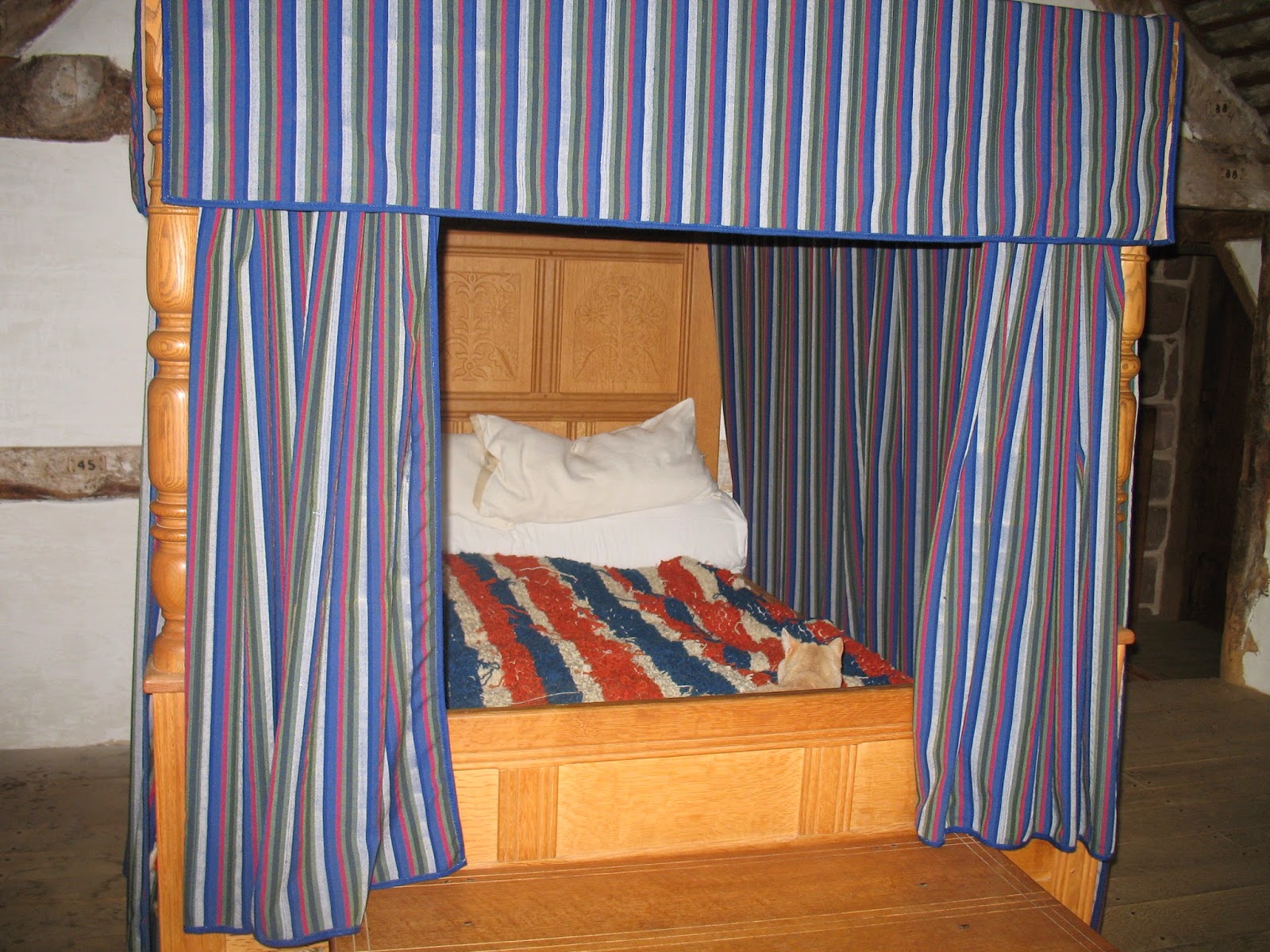
Bed curtains were used both for warmth and for privacy.


Our guide offered a pretend dinner party in the dining room, using the plates, etc there.

Next we visited the Irish farm with its rock walls.


This is where they were preparing flax for spinning.  The portion of the flax that is used is a fiber inside a woody stem, so this lady is using a flax brake to crush and break up the woody parts to gain access to the fibers inside.  The usable flax looks like blond hair when properly prepared.  A hunk of prepared flax is called a 'tow'.  This is where we get the term tow head for a blond haired child.  Sometimes such a hair color is also called 'flaxen haired'.


The next site we visited was the German farm where they were spinning the flax.  When flax is spun, the fabric is called linen.  It was common on the frontier to make a sturdy fabric called linsey-woolsey which was a combination of linen and wool.


The kitchen had a raised hearth which seemed much less back breaking to me.


After the spinning was done, weaving was done in a sunny room.


The German farm interpreter had on a laced bodice over a chemise.  One of the men in the group kept nattering about it...wondering about it.  She nicely and tactfully told him several times that is was sort of like an under garment but was worn over the chemise and had boning in it.  The man just would not quit with the questions until finally his wife poked  him and said, "It's like a bra!"  Then he shut up.

The last stop was the America farm which combined features and practices from all the other sites which were found to work best on that part of the American frontier.


It was an enjoyable trip and we learned a lot.

Tuesday, January 6, 2015

When the Wind Blows

When we left on December 19th for our planned Christmas vacation in Colorado, we commented on the lovely driving weather.  Our trip across Wyoming was pleasant and uneventful.

After visiting with family over Christmas we decided to head back home on January 5th.  Although snow had fallen during our stay in Colorado, the forecast for the 5th seemed like it would be a good weather day to travel.  Thus, we set off, bright and early, stopping for breakfast in nearby Loveland.  After breakfast, we headed north towards Cheyenne, still enjoying our drive.

After turning west at Cheyenne, the weather started to change.  Although it was not actively snowing, blowing snow made the visibility very poor.  We couldn't even see the side of the road, so we focused on the flashing tail lights of the truck in front of us to make our way.  The gusts of wind grew increasingly vicious.  Soon we began to see semis parking along the side of the road.  In spite of the weather and slowed traffic, some drivers drove on as if the road were in perfect condition.  One that I recall was a pickup truck pulling a long horse trailer.  A couple of semis had been caught by the wind and turned over.  The emergency traffic broadcast on the radio gave warnings especially to vehicles with light, high loads.  I noticed a few on ramps were blocked so the freeway couldn't be entered from these points.

Our plan was to drive as far as Laramie and then fill up with gas so we could make it the rest of the way across Wyoming.  When we got to exit 310 at Laramie we headed off the freeway to get our gas, noticing at the same time that the gates had been closed on the west side of Laramie.  The road in front of us was closed...and so was the road behind us.  While we were filling up with gas, Roger talked with some eastbound truckers who said road conditions to the west were terrible.  They were sure the road would be closed all day and maybe more.  That is when we noticed that the sides of the road were filled with parked semis.  The 2 truck stops there were filled with semis.  Every vacant lot was filled with parked semis.  I have never in my life seen so many semis parked in one place.

They are difficult to see in the picture but they are lined up on the side of the road from the on ramp for maybe half a mile.  They are visible behind the Super 8 sign.

We debated what to do and then decided to check into the Best Western motel that was right there rather than sit in the car all day waiting for the road to open.  Then we found a local grocery store and found food for lunch and dinner.   After a refreshing nap, we headed to the local movie theater to watch the newest Hobbit  movie.

By the time we woke up the next morning, the freeway was open and traffic was moving again, so we ate breakfast and finished our journey home.  We noticed a total of 13 vehicles which had blown over and off the road.  Eleven of them were semis which had turned over or jack-knifed or both.  One was a 5th wheeler...and one was the horse trailer we saw speeding by the previous day, destroying both the trailer and the truck.

Friday, October 31, 2014

Brigham City - a day of nostalgia

For Mom's 91st birthday this year we took her to Brigham City so she could show us various sites of interest to our family. Before starting we fortified ourselves with a visit to Maddox, a business which was started by Mom's distant cousins, Irv and Wilma (Kotter) Maddox.  It has become a destination restaurant now.  After dinner, our tour began.

It was about 1903-4 that the family of George Richard and Euphemia Jane Freeman came to Brigham City.  The two oldest boys left England first, with the rest of the family following a year later.  George Richard Freeman's family were shopkeepers and shoemakers for the most part.


Bert, Ernest, Wilford, Alf, Ida
Annie, George R., Euphemia Jane, Harry


Their first home in Brigham was a rental south of the Tabernacle.


The employment they were hoping for in Brigham City didn't work out, but they were offered a chance to buy a farm just east of town.  The house on the farm wasn't much more than a shack that has long since disappeared.  Farming was a new experience for the family. They had no farm implements at first but eventually bought an old horse and wagon and learned to plow and milk a cow.

 Hillside Farm -about 1935

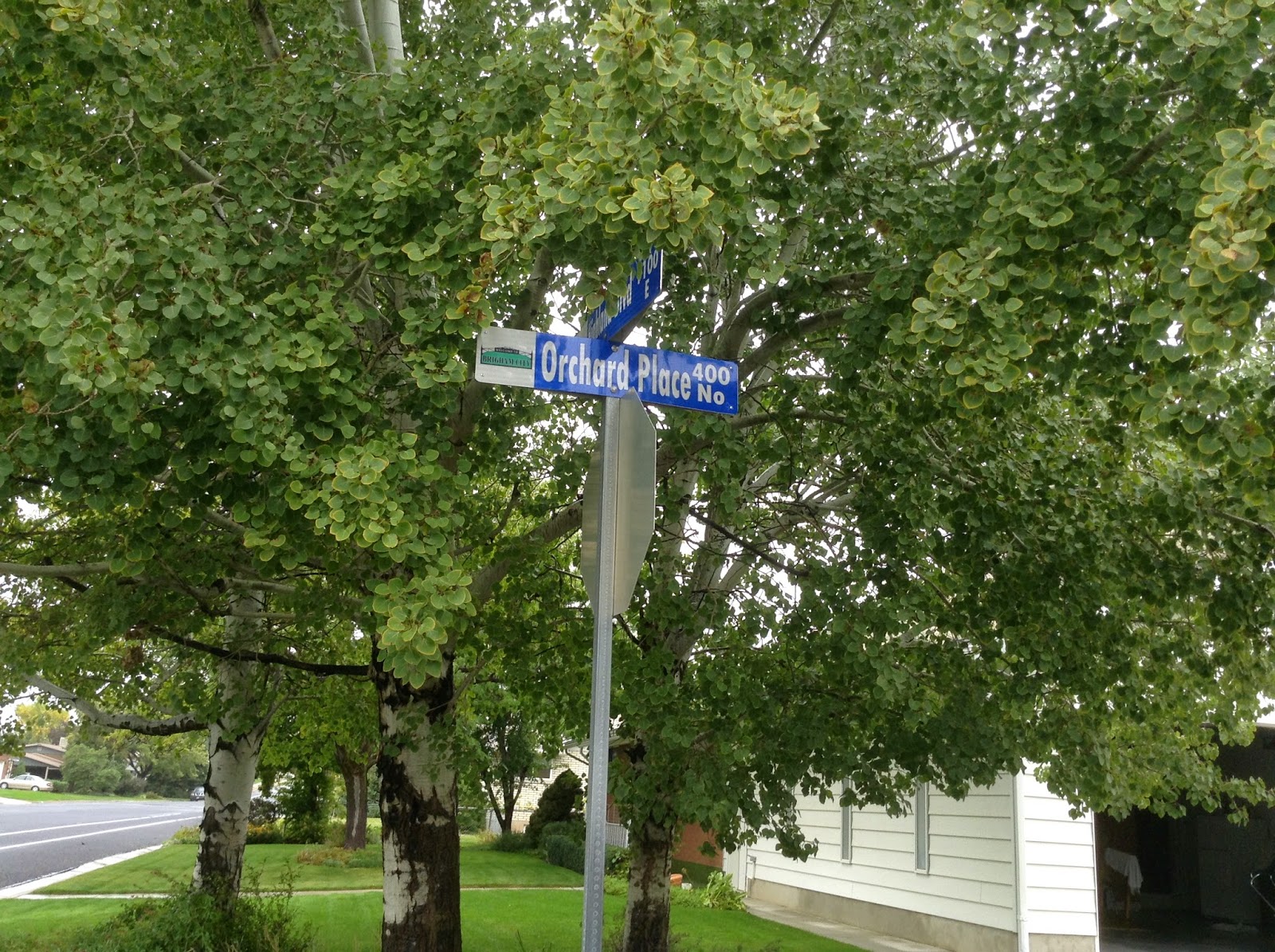
Today the old shack is gone and the farm that was out of town is now a neighborhood on Orchard Place.  The modern home is on the site of the old shack.  There used to be a pond above the house on the mountainside.


 Several of the children and grandchildren of George R. and Euphemia Jane lived in Brigham after they grew up. Most of their homes have now been modernized, so look a bit different than they did in the old days. 
Wilford Freeman home.  It has no carport in the old days.


Alf Freeman home

When Ernest and Ruby Freeman were first married, they lived with Ruby's mother.  Later, they bought the home of Ernest's parents on 2nd North and 2nd East.


Rather than irrigating with sprinklers, the stream of water came to the lot twice a week for a certain period of time.  The gates for the water were under metal covers.  When it was time for the water turn, Ernest would open the metal cover and put his hoe down into the hole to pull the gate cover off one pipe so the water would then run into his garden.

 Dean Freeman home

The Kotter family arrived in Brigham City earlier than the Freemans, in the 1860s.  Henry Kotter had a farm north of town which he gave to his sons to run after his first wife died.  In 1893 he married Minnie Erickson and built a house in town.  He died in 1916, but she lived in that house for 20 more years.

 Kotter Family
 Ruby, Herman, Etta, Victor,
Elmer, Wendell,
Gertrude, Minnie, Norma, Homer


Ernest's children fondly remember visiting their Grandma Kotter.


Dean's aunt, Norma Kotter Hodson, bought the house next to him.  Her father, Henry Kotter, was a brickmaker.  The walls of the original part of this house were very thick because they were built of adobe bricks made by Henry Kotter.  Even without air conditioning, this house was cool in the summer because of the thick walls.


Kids in Brigham City attended seminary in the old seminary building which is still there.


 The old Relief Society granary building is also still standing.


Another enterprise important in Brigham City history was Baron Woolen Mills which is still standing though it has been destroyed by fire.


It was fun to drive around and reminisce with Mom and hear her stories about the old days in Brigham City.


Sunday, August 31, 2014

Amelia's Magic Box

Amelia and her great-grandma came to stay at our house for a few days.  Shortly after Great-grandma went shopping, Amelia discovered a magic box.  It looked like an ordinary box of Peanut M&Ms, but when Amelia opened the box, only one piece of candy was there, so she ate it.  Later she found the box on a chair and picked it up.  It rattled!  Something was inside!  It was another piece of candy! So, she ate it.  A few hours later she found the box on the table, so she picked it up again...and it rattled again, so she opened it up and ate it.  This happened several times during the day.  That magic box kept refilling itself with candy!


This morning when Amelia woke up, she found the previously empty magic box..and guess what?  A candy was inside.

I would very much like to have a box like this!