Tuesday, June 6, 2017

D-Day - Brigham City man recalls Exercise Tiger, a 'forgotten' D-Day rehearsal

Fortuitous that I found where I tucked this article away...just at this time of year.

From an article in the Box Elder News Journal, Wednesday, May 25, 1994 of an interview with my uncle, Dean Freeman, about an experience he had 73 years ago.


The eyes of the world will turn to the beaches of Normandy on the 50th anniversary of D-Day, but its dress rehearsal Exercise Tiger--a disastrous operation that cost the lives of 749 American servicemen--has almost been forgotten in history

Along with other veterans of the incident, Dean Freeman of Brigham City knew at the time why it wasn't reported.  It would have tipped off the Germans that the Normandy invasion was imminent.  "It was top  secret.  Nobody could write home about it," said Freeman.  "We knew we were going to go ashore in France, but we had no date or place."

                     
                                                            Dean Freeman


But why Exercise Tiger remained classified information until 1974 was a mystery.  It was another ten years before Dr. Ralph Green of Chicago, a medical officer who treated some of the survivors, wrote about it.

Exercise Tiger, involving 3,000 ships and 30,000 men in full battle dress, was the U.S. 4th Infantry Division's final practice for D-Day.  The ships sailed into the channel to practice a landing at Slapton Sands in preparation for the real thing.


What began as a drill became a death trap.  Nine German torpedo boats operating out of occupied France happened onto eight LSTs (landing ship, tanks) that were part of the convoy.

On April 28, 1944, Captain Dean Freeman was on the upper deck of an LST of Convoy T-4, when shortly before 2 a.m. the two LSTs following it were struck by torpedoes.  He heard an explosion, that was all.

"I was the officer on duty on deck.  It was quite a ways behind, and I wasn't sure what was happening," said Freeman.  "We didn't know until morning.  The sound wasn't that unusual; every night there were German planes and anti-aircraft action."

With records declassified, now it is known what happened.  German boats, traveling at 40 miles per hour, darted about the lumbering LSTs which moved at about 5 mph.  Two LSTs were sunk and a third was damaged in 30 minutes.

The final toll of 551 soldiers and 298 sailors dead and 89 wounded made Exercise Tiger the most deadly U.S. training exercise during World War II.

"They went down within a few minutes.  There was one strange story.  One company commander and one sergeant were blown out the hole where the torpedo went in, and they both lived.  The explosion of the torpedo inside blew them right out the hole."

Most aboard the ships weren't so fortunate.  Of about 1,000 men in Freeman's battalion, 230 lost their lives.

"After it happened, we went back to the staging area for 20 to 30 days.  There was a building set up for a morgue, and a month was spent trying to identify what bodies had been recovered.  It was a terrible job," he said.

A number of errors worsened the tragedy.  Only one British ship guarded the convoy and a typographical error caused American ships to tune to the wrong radio frequency.

Men buckled flotation belts around their waists instead of under their arms.  Loaded with field packs, rifles, ammunition and steel helmets, many who jumped into the water turned upside down and were found floating feet up.

Since the operation had been a full rehearsal for D-Day, all but the men's personal gear had been taken along.  Military and payroll records went down with the ships, so it was a scramble to put those records together.

Freeman continued, "One odd thing, all those records of men and officers were in a waterproof box in one of the vehicles on the LSTs that went down."

"After landing on the continent we made new records.  about four months after D-Day, they brought the mail and there was the box, with records readable although it was burnt all over on the outside.  It was found floating down the channel to Plymouth Harbor."

On June 6, 1944, Freeman landed on Utah Beach with the rest of the 577th Quartermaster Battalion.  They climbed over the sides of the LSTs to LCVPs (landing craft, vehicles, personnel) which held 30 to 40 people.


When the LCVP got close to the beach, the front dropped and soldiers headed onto the beach as the engines went into reverse and headed out to sea.

Water was anywhere in depth from "knees to armpits or higher" said Freeman, who held his arms up to show how weapons were carried "any way you could."

"We had lifejackets, kind of wrap-arounds, with CO2 tubes to inflate.  We used those later as air mattresses in the bottom of fox holes," he added with a grin.

Utah Beach was all flooded for about a mile due to dikes erected by the Germans, so they waded for about a mile inland.  German pillboxes above had pretty well been taken out by shelling, bombing and paratroopers.

"Our assignment was to keep the beach open, so Patton and all the others could come in.  As an administrative and quartermaster unit, we were responsible for getting rations, gasoline, and ammunition to personnel in the field," he added.

He went on to Cherbourg, France, and later to Liege, Belgium, where he was stationed when the war ended.

Spending Thanksgiving Day on the train, he arrived home in late November 1945--two years from the time he departed for Europe in 1943.  It was the first time he had seen his son, born a month after his departure.  His wife Florence had remained in Logan with an aunt.

Although he had been a member of the local National Guard unit that went to war together, Freeman enrolled in ROTC at Utah State Universidy and was called up the day after his graduation in June 1942.  He attended officers school in Wyoming and Georgia prior to assignment in England.

Until an article about Exercise Tiger appeared recently, Freeman said, "I had never seen anything in print, except a little article a few years ago.  I guess there was a documentary on television on April 28, but I missed it."

Although he wouldn't have come forward with his story without urging by his wife, Freeman is glad Exercise Tiger is getting some attention and those who lost their lives are being honored.

On the 50th anniversary of Exercise Tiger, Americans went to Slapton Sands for services at the cemetery and then dropped a wreath in the channel for those who went down with the boats.


Monday, March 27, 2017

I Must Have Had a Wonderful Childhood

     A friend recently commented that I must have had a wonderful childhood.  It made me pause and think.  Did I have a wonderful childhood?  What defines a wonderful childhood? I asked my husband what a wonderful childhood is like.  He said I had plenty to eat and a nice place to live.  Is that all there is?  There must be more than that.
Is it prosperity?  I know plenty of prosperous people who don’t seem particularly happy.
    My childhood began in Kansas where my father was a student.  We lived on a student stipend on the third floor of a a small, rented house.  The whole floor slanted toward the chimney.  The bathroom was on the landing between the second and third floors and was shared with the second floor tenants. We had no car.
   We left Kansas when I was two years old during severe flooding.  Dad and other volunteers manned the levees until the whistle blew to tell workers the levees were breeching and that they needed to get to safety. Ten years later, when I revisited the town, water marks were still visible in some older buildings that hadn’t been repainted.
   As a small child I had frequent, painful ear infections…often as much as once a month. As soon as I turned four, I was taken to the hospital for surgery to remove my tonsils.  They promised me all the ice cream I wanted when the surgery was done.  They didn’t mention that my throat would be so sore I wouldn’t want any ice cream.  When they put the ether mask over my face I was terrified.
   I longed for siblings but had none until we adopted a brother when I was five.  The social worker who came to visit before the final adoption accused my parents of only wanting a playmate for me.  She tried to get me to say that I didn’t want him!
   For some reason, I never knew I was shy until we moved when I was seven.  Changing schools was excruciating. It was so hard for me to make new friends.
   It was also when I was seven that a teenager in our ward, Tommy Scott,  was murdered. I couldn’t understand why a person would do such a thing.
   By the time I went to school we lived in Indianapolis. At school they taught us to grab our coats and line up in a windowless hallway, squatting down facing the wall with our coats over our heads for tornado drills.  I also recall several times at home during tornado watches when our family adjourned to our basement until we heard the all clear on our radio.  Fortunately, the only time a tornado actually caused damage in our yard we were away on vacation.  The area a mile from our home looked like matchsticks.


   As a 4th grader, I realized that my father could not make everything right when my friend Sue quit coming to school.  We eventually found out that she had surgery for a brain tumor and was severely disabled as a result.  As an adult, she became the center of a right to die lawsuit.
   The next year one of my father’s co-workers, whose children I often played with, died suddenly as a result of a brain tumor.  I remember him coming to our home in his pajamas to say goodbye before going to the hospital.
   During some of these years we were members of the Keen Kutters ice skating club.  We skated at The Coliseum in Indianapolis.  Usually we just skated for the fun of it, but sometimes we took lessons from Dan Ryan and wife who were professional skaters.  When I was 12, Mr. Ryan travelled to the World Figure Skating competition in Belgium as a coach. During that trip, Mr. Ryan and the entire US Olympic figure skating team died when their plane went down in Belgium.  He was only 31 and left behind a wife and five small children.


I was 14 when a girl in our ward died suddenly and mysteriously.  The only reason I ever heard for her death was that she had a bad cold.  I wondered for years what actually caused her death and with the naivety of a child wondered if I would die when I had a cold.
   Again at The Coliseum during my freshman year of high school, Holiday on Ice was in town to perform.  Opening night was on Halloween.  Thankfully our family didn’t attend, but my best friend and my high school band director were both in the crowd of over 4000 people.  The perimeter of the arena gave access to the area under the seats and was used for concessions.  During the finale of the event, a propane tank for a popcorn  machine exploded, destroying the seats above it.  My best friend found herself outside with no shoes and no explanation as to how she got there.  The section of seats right in front of her had been destroyed in the explosion.  My band teacher told of holding a dying victim in his arms.  There were 74 fatalities and more than 400 injured.


   When I was 16, one of my good school friends, Marianne Sikes, a sweet and kind girl, was murdered, along with her younger sister and her mother, by her father.
   Even after living through all these unfortunate experiences,  I survived.  In retrospect, I see that some of these experiences had a lasting impact on my life. But in spite of everything that happened, I do think I had a wonderful childhood.  Thank goodness I had loving parents who supported me and protected me as much as they could.  Somehow they helped me discover a sense of resilience in the face of adversity.  Now as I look back and choose what to write about, I find that I usually am more drawn to the fun and positive experiences.  As for the negative experiences, I am more able to see the humor in them and how much I learned and grew from them.  As hard as it was, I am a better person for having had my particular ‘wonderful’ childhood.

Wednesday, February 8, 2017

Tommy Rock....confectioner


Samuel Freeman was born nearly 200 years ago, 4 March 1806, in Olney, Buckinghamshire, England.  He and his wife, Elizabeth Ann, had three children before she died at a young age.  One of those children, Richard, born in 1835, was my great-great grandfather.  Samuel remaried and had another son named Thomas. Young Thomas had a real fondness for sweets.  He, and probably the other children as well, liked to hang around at their father's sweet shop.  There Samuel sold biscuits, sweets, powders for drinks and jams.  Thomas was particularly fond of hard candy, called rock candy.  Because of this he soon earned the nickname Tommy Rock.  It is unclear whether Samuel made the rock candy he sold himself, but it seems likely that he did.
From British census records, it seems that after Samuel died in 1875, his son Thomas Freeman (Tommy Rock)  took over the business at 12 High Street in Olney.  In later census records, Thomas lists his occupation as fruiterer and confectioner.  It sounds like the legacy of making candy canes continued through Tommy's family.  The census records show that Thomas eventually married Susan Adams,  who was probably the widow of Walter Willey.  Her children appear to be the only children Thomas had and raised.

The picture below appeared in a book called "Around Olney in Camera".  It is captioned as follows:

"Mr Thomas Freeman's fruit shop at 12 High Street, decorated for the coronation of Edward VII in 1902.  The people were probably Mr and Mrs Freeman, with their son holding the horse, and daughter standing by."

I suspect the label is not entirely accurate.  It could indeed be members of the Thomas Freeman family.    Thomas was born in 1845 and his wife Susan, about 1843. Susan's children (Thomas' stepchildren) were Harry Willey b. 1865 and Mary Elizabeth b. abt 1867, so in 1902 they would have been adults.  More likely these are the children of Harry Willey and his wife Emma Amelia Fletcher, Thomas W. Willey b. abt 1888 and Elizabeth Amelia Willey, b. about 1889.  This would make them about 14 and 13 at the time of this picture.


Close examination shows another woman and child on the balcony just above the horse's head.  Harry Willey did have another daughter who would have been about 7 years old in 1902.  Two women are in the picture.  They are probably Susan Adams Freeman, wife of Thomas Freeman and Emma Amelia Fletcher Willey, wife of Harry Wiley.

By 1902, Thomas Freeman's older half-brother Richard and his wife, Charlotte Emma Goss Freeman had both died.  It was about the same time that Richard's oldest child, George Richard Freeman left with his wife and children to emigrate to the US.

The festive bunting on the front of the shop reads "God Save The King"

If you wonder how the Freeman family made their candy, click here!

Tuesday, December 27, 2016

Our Hands Can Become His Hands: A Little Christmas Miracle

Two year old Lucy was excited for Christmas to come soon.  Her family was busy making Christmas treats, wrapping interesting looking packages, decorating the Christmas tree and getting ready for company to come spend the holiday with them.  Lucy loved the tree with its shining lights and beautiful ornaments.  As the children made their Christmas lists, Lucy could only think of one thing.  “This Christmas, I want a little Christmas tree of my very own!” she said.

A few days before Christmas, Lucy wasn’t feeling very well.  Her mother took her to the doctor who sent them off to the ER where Lucy was admitted to the hospital.  It was scary at the hospital and she didn’t like the things they did to her there to help her feel better.  They hoped she would only have to stay one night so she could go home to her family by Christmas Eve, but Lucy was still too sick to go home, so she and her mother prepared to spend another night in the hospital.  Maybe, just maybe, she’d be able to go home on Christmas Day.


Lucy’s dad was left to entertain their company and make the final preparations for Christmas morning.  Lucy’s brother and sisters were not even allowed to come to the hospital to visit her.

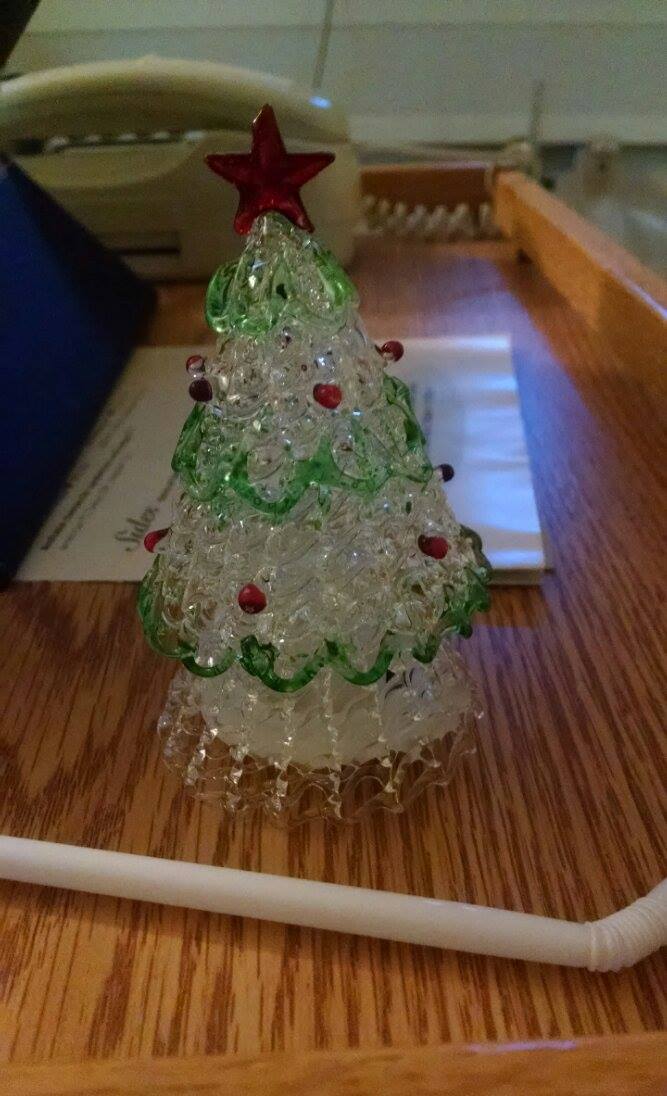
On Christmas Eve as Lucy and her mother cuddled together in her hospital room, an elderly lady from a nearby assisted living home came to the door.  She had brought toys for the children in the hospital and had even remembered the mothers there with their children.  She brought Lucy a little stuffed animal, but Lucy’s eyes opened wide when she saw what was in her other hand. The lady had intended the gift for Lucy’s mother, but Lucy just knew immediately that it was for her!  It was a beautiful glass Christmas tree that lighted up and changed colors.  Just what she wanted! Lucy didn’t let that tree go all night.  She slept with it cradled in her arms.


As her mother said, “Christmas in the hospital is not ideal, of course. Mary and Joseph may have preferred it to a stable. So I won't fuss too much about it. Lucy only put one thing on her Christmas list this year- her own little Christmas tree. Last night a little old lady from a nearby assisted living center brought by some gifts. Lucy got her own little light up Christmas tree. I'm sure this lady had no idea, but did what she could and that was exactly what was needed.”

While Lucy slept that Christmas Eve, Santa even found all the sick children in the hospital and remembered them with gifts, but one of the best gifts of all was when her family was given permission to come see her on Christmas Day for a little while.

Happily, Lucy passed the test of being without extra oxygen the day after Christmas and was able to go home at last!

So many people made her Christmas better…her doctors, nurses and other care givers, her family, the elderly lady, and those who prayed for her recovery.  As Pres. Uchtdorf said, “As we emulate His perfect example, our hands can become His hands; our eyes, His eyes; our heart, His heart.”  It is not unusual for Heavenly Father to use us to bless the lives of our families and friends.

Wednesday, December 14, 2016

As Time Goes By - Grandma and Grandpa

In the summer of 1961 I got to spend a couple of months with my grandparents.  I was 12 and they were OLD.   They tried their best to keep me entertained and I really wasn't a high maintenance kid, so we got along just fine.  Their lifestyle was a bit old-fashioned, but I enjoyed it for the most part.  When I was at loose ends, I just found a book to read since I enjoyed that. 

My grandparents never had a dishwasher, so after each meal we went to the sink where we washed and dried the dishes before putting them away.  Paper plates were for picnics, not regular meals.  In the morning after breakfast, Grandpa and I went out to feed the chickens he kept in his back yard.  They did not live on a farm.  Often Grandpa would go out and rototill his large garden and get his ditches ready for his irrigation turn.  When Grandma did laundry, we went down the basement and washed the clothes.  At that time she had a double dexter washer.  After we got the clothes all washed and rinsed, I helped Grandma load them into a laundry basket and then carried them up the stairs and out to the clothesline for her because it was hard for her to do because she was old.


The clotheslines were in the back yard in the hot, dry, summer sun.  We hung up everything with clothespins.  The bedding was hard for Grandma to handle because it was heavy....and she was old, so I helped her with it.

Sometimes when I was working with Grandma she would grimace a bit and ask me to go get one of her dynamite pills.  I thought it was funny that she called them dynamite pills.  They were really nitroglycerin pills.  Grandma almost always wore a dress, with a girdle and nylons.  (She was really excited when pantyhose were invented!)  Her shoes were those black, oxford 'old lady' shoes.  I vowed I would never wear such shoes.  They were for old people.  (Many years later I couldn't believe that my daughters willingly wore similar shoes.)

Sometimes it seemed like we barely finished breakfast when it was time to start cooking dinner, because Grandpa and Grandma ate dinner in the middle of the day.  Sometimes Grandma would send me to the basement to get food out of the 'fruit room' because going up and down the stairs took her too long because she was old.  I went much faster.

Grandma came from a large family.  Her father had 8 children with his first wife.  When that wife died, he remarried and had 9 more children, so all the children had to help.  As the second oldest of the second family, Grandma was assigned to do all the sewing for the family, so she became a really good seamstress.  She liked to help me do sewing projects.  We walked downtown to get fabric.  We didn't get patterns because Grandma always made her own patterns.  We didn't drive.  Grandma didn't ever learn to drive...because she was so old that cars were hardly invented when she was young.

Grandma liked me to help her put curlers in her hair.  She was so old that it hurt her arms to hold them above her head and put her own curlers in.

When Grandma's cherry tree got ripe, she liked me to climb up the ladder to pick the cherries while she handed me buckets from below....because she was too old to climb trees and ladders.

Sometimes in the evening, Grandpa drove us out to visit Uncle Herman's farm.  Herman was Grandma's younger brother.  We always took large, glass gallon jars with us.  Herman filled them with fresh milk from his cows.  Grandma always wanted to stay at the house and visit with Aunt Thelma while I ran out to the barn to watch Uncle Herman milk...and sometimes squirt milk into the mouths of the barn cats.  I think Grandma was just too old to run anymore.

Yesterday I was thinking about Grandma and wondered just how old she really was that summer.  I was startled to realize that she was 66...just a year younger than I am now!


Friday, November 11, 2016

Fisher House


Today is Veterans Day, so this seemed an appropriate time to tell about a recent visit we made to a large VA hospital complex.  My special vet has some health conditions which require occasional visits to a VA facility nearly 100 miles away from our home.  We are fortunate to live so close.  Many others have to travel much further than we did.  We saw cars there from Utah, Idaho, Montana, Colorado and California.  Since my vet had an early morning appointment, we chose to drive down the day before rather than starting out before daylight and finishing in rush hour traffic.  We had been told that we could stay on the VA campus, but I was not looking forward to it.  I imagined some grim, drab military building, sleeping on cots. 

Instead we found a place called Fisher House.  There are apparently Fisher Houses on or near many military complexes.  Ours was on the grounds of the George E. Wahlen Medical Center in Salt Lake City.  Fisher House serves the families of vets who are there for treatment, from one day to extended stays.  What a blessing this is for these families.


After checking in, we were given a tour of the house before being shown to our room.


We were given our 'keys' to the building and our room which was beautiful as well as handicapped accessible.


In addition to the bedrooms, there were many communal rooms.  No food was allowed in the bedrooms, but a beautiful dining area was provided.  During meal times, it was a great place for families to get acquainted.


The communal kitchen had around 5 refrigerators with compartments for each room to keep food as well as quite a bit of basic food which was donated for the use of everyone there.  On the night we were there, we didn't even need to prepare our dinner.  A group of folks from the 729th  Air Control Squadron along with a member of the Idaho Air National Guard showed up and took over the kitchen where they made everyone a nice spaghetti dinner.  There were also little cupboards in the kitchen for each bedroom's residents to keep food.


Next to the kitchen was the laundry room.  We didn't need to use it since we were there for just a night, but others were keeping it busy.  When we first went in to the laundry room to look around a lady apologized,  "Here, let me get that (prosthetic) leg out of your way!"


A large DVD collection was in the hall and the library area was stocked with books.  Computers were also available for use in the common areas.


Even though it is November, the weather was beautiful.  People were relaxing on the patio when we arrived, although no one was using the provided grills at the time.  In the background we could even see a little play area for children.


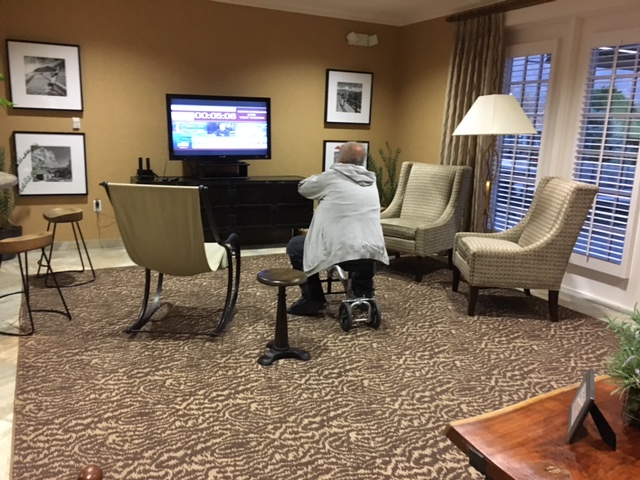
We were there on election night, so the TV room was tuned into the election returns.  Anyone who didn't want to watch the election was able to watch whatever they wanted on the TVs in the bedrooms.


Our particular Fisher House was dedicated to the memory of Chance Phelps, USMC, who was buried in nearby Wyoming.  Our room had a copy of a DVD movie made about him called 'Taking Chance". 
If you decide to watch it, keep your tissues handy. 


The staff and facilities at Fisher House were wonderful.  They are a true blessing in the lives of the families who stay there.  If you ever have occasion to be treated at a VA facility with a Fisher House, I highly recommend that you give it a try.  

Wednesday, November 2, 2016

Freezer Meals for Seniors Revisited

A few years ago I started helping my favorite seniors with their meals by putting easy to heat entrees into their freezer.  I am still doing that for one of my favorite seniors.  These are some updated observations and considerations.

1.  In many areas, an option such as Meals on Wheels is available for seniors.  Meals are often also provided at senior citizen centers.  For our family these are not an option.  Our senior has difficulty swallowing and chewing food as well as very specific likes and dislikes.  Most food provided by Meals on Wheels  is either too difficult to chew and swallow, or something on the 'dislike' list.  In addition, many seniors have health concerns which necessitate watching carbs, calories, fats, or salt.  It seems to me that most institutional food is difficult for this group.

2.  As time has gone on, our senior is having greater mobility issues which make it difficult to spend much time cooking.  As a result, her nutrition has suffered when she doesn't feel up to cooking.  Lack of appetite is also a consideration.

I started this project by doing entrees for my seniors, but recently, it has made more sense to provide a complete meal.  If I want to be sure my senior will eat the meals I need to find out what foods sound good to them and then prepare the meals in a form that can be eaten.

A couple of days ago, I was planning to make containers with meat, mashed potatoes and vegetables, but when I arrived to make the meals, my senior expressed a desire for Funeral Potatoes, so I cancelled the mashed potatoes for this time.  She loves roast beef, so we stopped in at Lower Foods outlet store and got a 2 pound package of  precooked, thin sliced beef ends.  I put the meat into a food chopper so the meat would be easier to chew and swallow.  Then I made a 9 x 13  pan of funeral potatoes.  Last I cooked some peas and carrots to a consistency that she could eat.

I put 1/3 meat, 1/3 potatoes and 1/3 vegetables into fifteen 9.5 ounce containers before placing the containers in the freezer.  A short warm up in the microwave makes a complete meal easy to prepare.


Since winter is almost here, I think the next freezer meal will be something warm and filling for a cold day.  My senior is hoping for a nice meal of ham and beans.