Saturday, June 15, 2019

Elizabeth Green Carter

I have no memories of Elizabeth Green.  She was a great-great grandmother who lived in far away England and died well before my time.   Many years later we moved to a small, northern Utah town where we lived for almost 17 years before it came to my attention that the far-away and long gone Elizabeth had left her home around the age of 79 and moved to America!  She had three daughters.  The oldest lived in England and had to work and was thus unable to care for her mother.  The youngest daughter had moved to America some years before.  When the middle daughter and her family decided to go to America shortly after the death of her father and Elizabeth's husband, Elizabeth determined to go as well.  In the story of her life, written by her middle daughter, we get a glimpse of her personality and adventures traveling across the ocean.  Elizabeth lived the last few years of her life in the same little town I now live in, so today I decided to try to find where she ended up.

                                      Elizabeth Green Carter

 Youngest daughter, Sarah Elizabeth Carter Wood who moved to the US some years before her mother.  She cared for her mother the last few years of her life.


Middle daughter,  Euphemia Jane Carter Freeman, with whom Elizabeth traveled to America when she was in her late 70s.


 There she was,  waiting here for me to discover her, right next to her daughter, Sarah Elizabeth Carter Wood and her granddaughter, Florence Ada Davis Gyllenskog.


I met Florence, who we called Florrie, when she was an elderly woman.  At the time I only knew she was a relative but didn't know how she was related.  Now I know she was my grandfather  Ernest Freeman's first cousin.


Florrie


Elizabeth, in spite of losing her mother at a young age, knew how to do many things:
1.   How to repair a sewing machine
2.   How to light a room brightly with a single candle.
3.  How to make a clothing pattern and make clothing
4.   Was able to make her own shoe uppers

She kept everyone on their toes while aboard the ship to America.   If you are interested in those things, read on.  If not...don't!

Elizabeth Green 1822-1906

Elizabeth Green Carter 1822-1906 of Loys Weedon, England by Euphemia Jane Carter Freeman 

 My mother's name was Elizabeth Green. She was the daughter of Richard Green and Elizabeth Branson and was born 21 August 1822 at Loys Weedon (Weedon by Weston), Northamptonshire, England. She was the youngest of 10 children and lived longer than any of her brothers or sisters. Her mother, Elizabeth Branson Green, died of cancer 21 December 1825 when my mother was a little over three years old. She was then cared for by her two older sisters and her father until about five and a half years later. By this time, both of her sisters had died and she was left at this tender age to practically take care of the home for her father. Her father, Richard Green, was a wonderful man. He took care of her and taught her how to cook, wash, do the housework, and take care of the home. She was about eight or nine years old at that time. Elizabeth being small, stood on a stool to do the dishes and laundry. Her father, a kind and patient man, taught Elizabeth how to do many things. He also taught her how to make uppers for her shoes. Then he would finish the shoes for her. When Richard Green could no longer care for himself, the vicar brought him to Blisworth, to live with his daughter Elizabeth and her family, to be cared for. This is a song he used to sing to them: 

        The cuckoo is a merry bird,   
        She sings as she flies, 
        She brings us good tidings 
        She tells us no lies, 
        She sucks little bird eggs 
        To make her voice clear, 
        Then she sings 'Cuckoo' 
        Three months in the year. 

Richard Green brought a 'Mormon tract' home one day, but it was never read and became lost. Mother had very little schooling. However, she attended some night school and learned to read and write and to sew. Thus she became a very good all-around housekeeper. When she was about fifteen years old, the wife of one of her brothers died and left a baby girl who was just 15 months old. Her brother brought the baby and came to live at his father's home. Mother took care of the baby and the home for all of them. This, or course, meant the end of her real schooling. Mother took care of this little niece until the girl grew up and married. During that time, my mother had a few weeks of night school and a little help in sewing. She taught herself to be a better seamstress because she could not get clothes for herself any other way. She used to unpick the sewing of her old clothes and dresses and then use them as a pattern to cut out the material for the new clothes. She got along in this way and learned to make almost all kinds of new clothes for men as well as for women. She made all of her father'
s clothes and later made all the clothes for her children. She also worked for an old lady who made lace. This lady could not sew very well, and she had Mother mend her husband's clothes as well as the other sewing and work. Mother would be at her place for a week; then when she got home again there was a lot of work waiting for her. People would bring their sewing and leave it so Mother could do it at home. Whatever Mother did, she did it well--her best. she always told us girls that if anything is worth doing, it is worth doing well, and we always remembered it. Everyone she did work for or who saw her work liked it. One dressmaker in Blisworth always had Mother help her with dressmaking because she like Mother's work so much. Mother was good to her neighbors. When they got material for their clothing for winter, they would take it to Mother and get her to cut out the material for them so they could make their clothes. If they had any other difficulties, they would come back to her for more help. In some cases she did the work for them. Her night sewing was done my candlelight. The candle was placed behind a large glass jar or bottle which was filled with water to diffuse the light. There were clothing clubs for winter, and the club members came to Mother and got her to make clothing for their men for winter. I have seen stacks of cloth in Mother's home, some cut out ready to be made up into clothes, some waiting to be cut out and some made up into clothing waiting for the people to come for it. She never charged anything for cutting out the material for people. I think that is one reason she was called on to do so much of it. Once a lady sent a pair of her son's pants for Mother to mend. In one of the pockets, Mother found a silver shilling. Mother said, "I wonder if that was put in there to see if I would keep it?" When Mother sent me to take the pants back she said, "You tell the lady about the shilling." I did so, but the lady did not say that Mother could keep the shilling. Some years later I worked for that same lady in service (lived at the home and did the house work). Elizabeth was thrifty and honest. If she owed anyone anything, she could be depended on to pay her debts. She had been doing all of her sewing by hand. Then after Polly started to work and sewing machines were available, she bought Elizabeth a sewing machine. It worked by hand (no treadle, just by the head), by turning the wheel by a small knob on the wheel. It was much easier than handwork and faster. When the machine would no longer work and no one knew what to do about it, she put it in a 'copper' and boiled it. After oiling, it worked as good as new. She made hundreds of men?s shirts besides large amounts of other clothing for men and women. In later years a man came to Elizabeth and asked her to make him a pair of trousers. He could find none which fitted as well as those she made. She had to say no. She would like to do them for him but her fingers could not pull the needle through the cloth anymore. I have often heard her say that if she had a shilling for every man?s shirt that she had made, she would be a rich woman. But as fast as she got money for her work it would have to go for something. Sometimes in the winter Father was out of work for weeks when the canal was frozen over, so Mother would have to be the breadwinner so she always had work to do for someone. Often she needed to go into debt to the baker for bread. She always paid him as soon as money was available. Mother was often asked to help in other ways. Whenever a baby was born to one of the neighbors, she was asked to go and help. She also went haymaking but she did not drink the beer that was allotted to her. She gave that to the men. there were no machines to do the work in those days like we have now. It was all hand work, and she went up the rows of hay and turned it over with a big fork so that it would dry. During and just after the grain harvest, she went gleaning in the grain fields, picking up heads of grain which were dropped as the grain was harvested, putting them into a sack. This was hard, tiring work. It was hard on the back, and then stubble cut and scratched her hands and arms. At the end of the day Mother put the sack full of grain heads on her head and carried it home. She went gleaning in fields several miles away from home and, of course, had to walk to the field in the morning and home with her load at night. This was done in order to help get flour for winter and many of the poorer people did this each year. When I and my older sister, Polly, were old enough, we had to go with Mother and help with the gleaning. We sometimes would stray off to the hedges and pick blackberries or go and hunt for crabs until Mother called us back to work. We walked two or three miles to the fields and then all over the fields to pick up the grain. Sometimes we would sit or lie down as we were so tired. One of Mother's neighbors was poor and had a large family of little children. Her husband's wages were small, and so it was hard for them to keep up with expenses. This woman came to Mother at times to borrow some money to help them along until pay day. The other neighbors did not trust this woman and told Mother not to lend her any money because they were sure she would never pay it back, but Mother loaned her a little money, and always, just as soon as her husband was paid, she returned the money which she had borrowed. Mother was kind to everyone and was always helping people who were worse off than she was, and seemed happy in doing it. Mother always said that she had a wonderful, good father, and she was very good to him for many years. It was always her father that she talked about. She hardly ever spoke of her mother because she never knew her and no one told her much about her. She was only 3 years old when her mother died. One of Mother's brothers went to live in Blisworth, a town just a few miles away. One time when Mother went to visit and help him, she met Henry Carter and later married him. Mother was 30 years and 11 months when she married Henry Carter in Blisworth on 11 July 1853. During all those years she was taking care of her father and brother and her niece. Her father never married again after his wife died although he was often advised to do so. He said, "It is easy to find a new wife but very hard to find a good mother for your children." When Mother got married, her father went to live in Wappenham and lived with one of his sons until he got so that he could not take care of himself and then the minister brought him to Mother so that she could take care of him. I can remember him quite well, especially one time while I was playing with some girl friends and I ran in the house to hide and found him lying along the top of the stairs. He had fallen off the bed and had pulled all the bed clothes off the bed as he tried to help himself up but was unable to do it. I ran along to Uncle Richard's place to tell Father and Mother about him. They had gone there to visit for a while. My mother cared for her father until he died at the age of ninety years. There were 4 children born to my mother and father---three girls and one boy. The oldest, my sister Mary Ann (known as Polly), then myself, Euphemia Jane, and then my brother, James Ira, who died when he was 16 months old,(I can just remember him.) and then my youngest sister, Sarah Elizabeth. I remember one time when I was home visiting with Mother that she had two large kettles of water, one on each side of the stove, boiling vigorously. I said, "Mother, why do you have so much water boiling?" Mother lived in a home just a short distance from the 'Workhouse' and it was getting close to winter. Mother said, "Well, I just want to be ready for the poor people who come to the Workhouse at night after their long walk from the villages around us where they have walked carrying articles that they have made or begged, to sell, so that they might have a little money to help them get along. Some have a little tea or coffee but no hot water and none of the other neighbors will help them, so I have some hot water that they can have to help them make a little warm drink to help warm them up. I have to have a fire anyhow, and it does not hurt me to help them, but it does make me feel good. Some of them do not even have tea or coffee, and I give them a little and also a little sugar to help them out. I am glad to do it." Then she said, "I hope that if any of my children need help sometime that they will find someone who will be kind enough to help them." The Workhouse was a place supported by the county where poor people could have a place to sleep and a breakfast in the morning. However, before they were allowed to leave in the morning, they had to accomplish a certain amount of work assigned to them which was the payment for their night's lodging and breakfast. They were assigned to do washing, scrubbing, digging, cleaning the premises, or anything which was necessary at the time. Whenever one of her brothers was sick or wanted to see Mother, a man would walk nine miles from Wappenham where they lived, to give Mother the message. She would walk back with the man, and when she was through visiting, she would walk home again. Mother was a great woman to walk. Although my mother did not walk across the plains and was not a pioneer, I think she was a great woman. She did just as much as they, only in a different way. She often tended some of the women when their babies were born, until they could do for themselves. When we girls were in service she made our dresses and sent them to us. Mother once took a little girl to take care of, for a woman who was always on a canal boat and therefore could not send her little girl to school. Mother thus made it possible for this child to get her schooling. She was always doing something for someone. Everybody always had a good work for Mrs. Carter as they used to call her. She was always kind and helpful to others; that is the way to make friends; that is the way our Father in Heaven likes his children on earth to do---love each other, help each other, and do all we can for each other?s benefit. Today people like themselves too much. Neighbors in those days used to help one another almost like one big family. People always found Mother to be a very honest person in whatever she did. She always liked fair dealings and honesty. She always paid her debts and did not owe anyone a penny when we left 'old England'. One night Mother went out somewhere before Father got home. When Father came home and found she had gone he thought he would play a joke on her, so he locked the door and went upstairs to bed. He thought he would lie there and hear her rap and call to be let in, but instead of having the laugh on her, she had it on him. He dropped off to sleep and when Mother got home she rapped and called but could not rouse him. She was wearing a very thick shawl so she wrapped it around her hand many times and smashed one of the windows and got in and went to bed. When Mother was a girl at home she wanted to mark her clothes. She did not have silk twist as they have today, so she marked them with her hair. When Mother was about fifty years old, something happened which at the time did not seem serious but which later developed into a very serious condition, almost resulting in her death. One day as she was doing the family washing and as usual, was stirring and pushing the clothes around and down into the hot water in the boiler with a round stick, she suddenly lost hold of the stick and somehow it was forced very hard up into her face. The end of it struck her lip near the left nostril. Although she did not pay much attention to it at the time, the blow injured her gum and cancer started to develop. It spread along her gum and down into her throat. She suffered for quite a long time. Then she heard of an old man in Northampton who had cured many people of tumors and cancers so she went to him for treatments. He told her it was a bleeding cancer and that it had probably been caused by a blow at some time. Mother told him how she at one time was struck by the stick as related, and he thought that was the cause of her present trouble. His treatment was very severe and caused Mother a lot of very intense suffering. It was necessary for my oldest sister, Mary Ann, to stay at home and take care of Mother and the home. I was out at work in Northampton and our youngest sister, Sarah was just about 10 years old and was, of course, at home helping. One day Mother called Sarah to her bedside and told her where to find her father's Sunday clothes, shirt, and handkerchief in case he needed them. Sarah was very much surprised and said, ?Mother, where are you going??...to which Mother replied, "I don't know." For some time, Mother had to have treatments every day, but she was finally cured. In the spring of the year 1902, after we had been members of the LDS church for about 12 years, the way was opened up for my husband and family to immigrate to America. Inasmuch as my father had died just a short time previously on 23 March 1902 and Mother was also a member of the Church and now alone, quite a problem faced us. I did not like to leave Mother behind when we left England, because my oldest sister had to work and would not be able to take care of her and my youngest sister was already in America and had been for ten years. So I decided, after talking with my husband, to bring Mother to America with us. She was delighted with the opportunity as she did want to see her youngest daughter, Sarah Elizabeth, and live with her for the remaining years of her life. Mother was 80 years old in August as we left England in June, 1902. She enjoyed the voyage across the ocean, was not seasick at all, and never missed a meal. She went all over the ship, even into the captain's cabin and also into the places where they were cutting meat and cleaning fish and getting them ready for cooking. One day she wandered into a cabin and saw a purse lying on the bed. She thought she was in our cabin, so she picked up the purse and went to find my husband. When she found him she said, "You should take better care of your money than to leave it lying on the bed. Somebody might take it." She gave him the purse and again told him not to be so careless with his money. My husband said, "Well, Mother, this is not my purse; mine is in my pocket." Mother laughed and went on her way. My husband opened the purse and found that it was full of foreign money. He took it to the elder who was in charge of the LDS immigrants and he in turn found out who it belonged to and returned it to them. Mother was hard to keep track of, especially so, as I was seasick the entire voyage and the rest of the family were sick for 2 or 3 days or more. We finally reached the home of my sister, Sarah Elizabeth, and her husband in Smithfield, Utah and Mother lived there until her death in March 1906. She was 83 years and 7 months old when she died and was buried in Smithfield, Utah. I don't know what else I can say in my mother's favor. I never knew anything but good about her. I hope she is at rest and that I shall see her again sometime.


Wednesday, March 20, 2019

Je me souviens - Meeting Annabelle


   After breakfast at the motel and a quick ‘merci’ to the breakfast attendant, it was time to brave the journey to Old Quebec where we had an appointment to meet our guide, Annabelle, at a hotel with a convenient parking garage.  The first challenge was to reconcile the instruction from our GPS, Lia (short for Liahona), and the street signs.  Roger was tasked with safely driving us while my role as navigator and co-driver, meant watching the street signs ahead and directing the driver.  The highway signs were directing us to “sortie” to the “ouest” and if the traffic slowed so there was no ‘circulation fluide’ or if there was a ‘risque de collision’ we had best be prepared for a quick ‘arret’.
   After a couple of inadvertent trips around the block, we found the parking garage and made our way to the lobby of the hotel where we were to meet Annabelle.  Knowing we had a 2 hour walking tour ahead of us, we made a quick stop at the doors marked ‘femme’ and ‘homme’.


    A few minutes later, Annabelle breezed in the door and greeted us enthusiastically.  She was definitely a proud Québecoise.  She took us first to the parliament building of Quebec. 


The exterior of the building featured numerous statues of famous French-Canadian historical figures and explorers.  “Sadly”, she told us, “they ran out of money to finish the building so were forced to go to the queen and beg for funds to complete the place.  Begging for anything from the hated English was like a dagger to the heart, but it had to be done.  The queen agreed to provide the necessary funds…with stipulations, namely, that the English royal crown be placed atop the building.  Quel dommage.  Nonetheless, they had to swallow their pride and agree.  Once the funds were given and the building completed, great care was taken to place a very large Quebec flag atop the royal crown.

   Annabelle was a fountain of information about the history of Quebec, dwelling often on the hated ‘Conquest’ of the French by the British.  It was clear that the Conquest was ever present in the minds of every citizen of Quebec, even though it happened in 1759.  Today their license  plates say, ‘je me souviens:— I remember.  There is no doubt in my mind what it is they are busy remembering.
   The narrow streets were full of tourists from the cruise ships that docked on the nearby St. Lawrence River. 
   It was clear from some remarks she made, that Annabelle’s family was very traditional Catholic, but that she herself was not religious.  At some point she caught herself making a negative remark about her religious roots and then worried that we might be offended by her remarks, so she asked, “are you religious people?”  We answered that we are religious but not of her family’s faith and that we were not offended. 
     “Oh…then you must be Protestant,” she said.
     “No, we are not that either.”
     “Well what religion are you then?”
     “We belong to the Church of Jesus Christ of Latter-day Saints…sometimes called Mormons.”
      We were dressed for a cool, rainy day walking around the city, in jeans, sweaters, hooded jackets, and sneakers.  Puzzled she asked, “but you are not dressed in long dresses and old-fashioned clothing!”  I think she had us confused with someone else!
    As we got to know each other we discovered that her father is the same age as Roger…yet thinking of her father she said, “You both seem so young…your faces just glow!”  So we gave her a nice tip.  Au revoir, Annabelle
   After our walking tour, we had a short time to wait before our afternoon bus tour, so we stopped at Le Chic Shack for a quick dish of poutine.  Since it appeared to be rather a yuppie restaurant, it served yuppie poutine.


    Shortly after lunch we were on the road to see the countryside around Quebec City.  First we stopped at Montmorency Falls, where we spent just an hour, which was fine with me since some idiot had the idea of   building a narrow walkway across the top of the falls as well as a rickety stairway that climbed up to that walkway.  I was glad not to have time to climb it because I would have had to turn down the ‘opportunity’.


We then visited the  Ile d'Orleans which is in the middle of the St. Lawrence River. The island used to grow much of the food for the city, and even now grows lots of strawberries. It also grows VERY expensive summer homes. We traveled all the way around the island, stopping to give the bus passengers the chance to buy lots of chocolate at the chocolate shop. Then we went to a copper art place and had a demonstration of how that is done before heading out to Ste Anne basilica to finish up the trip. After returning to Quebec, we ate dinner in the old city before coming home. Fitbit says we walked 5 miles that day.


Thursday, January 17, 2019

Into the Woods - Fredericton, New Brunswick


  We arrived in Fredericton, New Brunswick, in the afternoon, tired from riding in the car.  A short distance from our motel we noticed a sign for a  botanical garden.  In late October, it seemed like a nice place to take a walk.  It was part of a small park, with a baseball field, the garden and a small wooded area. 
   After parking, we decided to go into the woods first.  There was no map, but it appeared that the trail through the woods would end up in the botanical garden near our car, so off we went.


   The woods were beautiful with tall spruce trees interspersed with the last colored leaves of the season.  The ground was bright with leaves that had already fallen.  As we walked, the sounds of city life quieted.  We heard squirrels scolding us as we walked along and birds chirping.  It was so peaceful, so beguiling.


   I kept looking for a path that went off to the left toward the botanical garden area, but our path just went straight ahead, so we kept walking.  A voice in my ear (okay…it was Roger) started to question where we were. “Maybe we should turn back.”  I looked back to see where we had come from and noticed that we had been walking slightly downhill.  I really did NOT want to walk back up that hill through places we had already seen, so we continued forward.   After half an hour or so we finally found a path to the left, but it certainly seemed like it was further than a path to the garden should have been.  Still, it WAS headed left, so off we went.  The voice to my side kept urging that we turn back, but I was determined, so we went forward, though the path was angling more and more sharply downhill. 
   The woods were still, very, very still.  I could hear no traffic sounds at all.  That seemed odd since the parking lot to the small botanical garden was near the corner of a busy intersection.  This path should NOT be this long!  The woods should NOT be this large!  Where was the city that surrounded the small botanical garden?  We had no choice but to go forward though the path veered more and more steeply downhill.
    Then I had a thought.  My cell phone would tell me where we were!   That is when we realized that the small botanical garden, went on for blocks, with buildings only on the edges of it. 
    Resolutely, we listened to directions from the phone and eventually found our way out to a busy road.   There we tried to figure out how to get back to the parking lot.  I didn’t like what I was seeing.  I didn’t like it one bit.  The route back on that sidewalk of the busy road was about 2 miles long and it was up a very steep hill.
   We had no choice but to climb the hill, of course.  The downhill course through the woods that had seemed so easy was less appealing.  Now we had to pay the price.
   Eventually we made it back to our car, exhausted and sweaty.
   Later, resting in our lovely air-conditioned room I started to think that this experience was so like our daily lives.  Sometimes we stubbornly insist on doing things our own way rather than listening to  the guidance of the Spirit.
   I remembered a scripture from Proverbs, “Trust in the Lord with all thine heart; and lean not unto thine own understanding.  In all thy ways acknowledge Him, and He shall direct thy paths.” 
   When we listen and pay attention, our paths through life are easier and clearer to follow.  We are less likely to get lost along the way.  It was a good reminder.

(20 October 2018)

Friday, November 16, 2018

Meeting Nordet


   I knew it was a mistake the minute I saw her, but it was too late for second thoughts.  She was a tiny thing, currently from France, but of Turkish origin, elegantly dressed in the French colors of red, white and blue.  Her name was Nordet.  The nearby children laughed merrily at her antics, but I didn’t trust her….not for even a minute.  At first she was on her best behavior, but soon she couldn’t keep up pretenses any longer.
   I sat down, waiting for her to make her move, my palms sweaty with anticipation and my stomach churning.  What was she going to do with us?  How did I let myself get talked into meeting her?
   It started many months earlier when Roger announced he had a bucket list item.  He wanted to drive to France.  I laughed.  “You can’t drive to France,” I told him. Then he showed me the map.  There, just off the southeast coast of Newfoundland, was a tiny island group, called Saint Pierre et Miquelon, still a part of France.
  I ignored him, hoping this idea would somehow pass, but it did not.  He was wrong, actually, he could not drive to France, but he could WALK and drive to get there, so plans were made and off we went.
   We drove across the US and crossed into Canada near Detroit, Michigan.  It was an adventure.  I didn’t give Nordet a thought.  
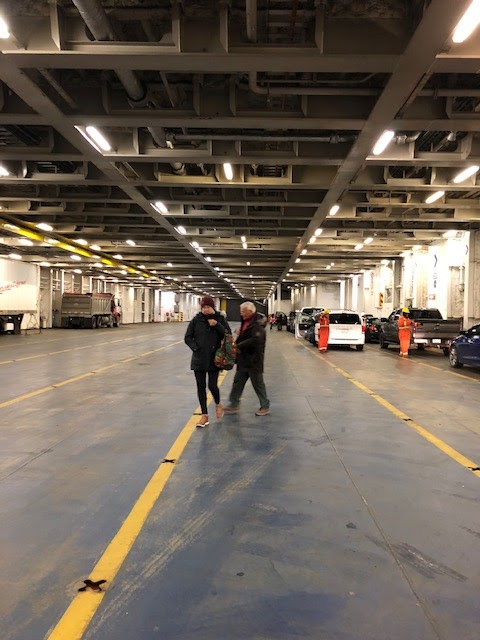
     After days of driving through Ontario, Quebec, New Brunswick and Nova Scotia I didn’t give Nordet a thought.  It was at Sydney, Nova Scotia, that we boarded the Blue Puttees, a huge ferry, named for  the 1st Newfoundland regiment, called the Blue Putteeswhich were decimated during World War I at the Battle of the Somme. We watched for an hour or so, as they loaded semi-trailers onto the ferry and wondered if there would be any room left for cars, but eventually we were waved aboard.  We parked on deck three.  I think the trucks were mostly on other decks.  It turns out that the ferry has over 1 3/4 miles of parking.  A few trucks were also on deck three with us.


   We were instructed to take everything we needed with us as the vehicle decks were locked while underway.  Huge chains hung down from the walls, waiting to chain down the vehicles…an ominous sign if you think about it.
   Deck seven had a lovely dining room where nice dinners were served.  Deck eight had berths, popular with people doing a night crossing, as well as a seating area.  Our seats were on deck nine.  Comfort all the way for us, with reclining chairs with a view out of the large windows.  We left Nova Scotia at 11:45 AM and arrived at Channel Port aux Basques about 6:30 that evening.  It was a pleasant journey.
    While there are a goodly number of roads in Newfoundland, only one, the Trans Canada Highway, goes all the way from Port aux Basques to the provincial capitol, St. Johns, on the other side.  Generally, the road is shaped like the letter C, tipped over onto its open side.  You get off the ship at one end of the C and travel mostly around the C, getting off a bit before the other end.  We liked the Newfie landscapes.  The first part reminded us so much of the area around Glennallen, Alaska.  The northern part of the route resembled the Kenai Peninsula and the final side was very much like the Denali Highway.
   We soon discovered Newfie food.  French fries drenched with gravy, hash browns and potato chips were served at every meal.  At grocery stores it was not unusual to see people with cart loads of potato chips.*  Of course, there was also abundant seafood…chowders, fish cakes, lobsters, salmon and others.  Hearty breakfasts everywhere always included a choice of breakfast meats…ham, sausage, bacon or bologna.


   Our last stop was at the little fishing village of Fortune.  Our hotel was beautiful inside with hardwood floors and a bed so tall that they provided a stool to help me get into bed.  The hotel had only eight rooms and no on site manager, so once they showed us to our room, they left us to our own devices.  As it turned out, because it was the end of the season,  we were the only customers there that night.  We had the entire place to ourselves.  At 10 PM, figuring that no other guests would be coming that night, I went out and locked the exterior doors.  I might add that the exterior of the Fortune Hotel did not match the luxury features of the interior.  It looked like a double wide trailer had been hauled onto the lot and skirted.  In fact, we both felt a bit off center when walking around inside…as if maybe the hotel was not quite level.


   The next morning when we awoke, there was a stiff breeze, but the Fortune Harbor was well protected from the elements.  Since we didn’t have to catch our ferry to Saint Pierre et Miquelon until 4:30 that afternoon, we had a leisurely lunch at Doc’s Diner.


Roger had delicious lasagna and I had their homemade chili.  We still had time to spare, so we went for a ride along the coast where we saw a sign that said, “Al Capone was here.”  Apparently during prohibition times, this was a hot spot for transporting liquor to smuggle into the US.
    At last it was time to go to the ferry terminal.  Since we were going to France, we had to have our passports with us.  I felt calm and at peace as we waited for the ferry to dock from the other side.  Many of the folks waiting to board were native French speakers.  One couple, of Basque heritage had their Labrador dog with them.  A French family with three small children and two strollers was also waiting.  Life was good.
     And then I saw her.  Nordet.  She was not at all like the Blue Puttees.  She looked like half a small, very small, ship.  In the front was an area with passenger seats.  The back of the ship, meant to hold maybe 15 cars, had only low sides.  Sadly, no cars could board the ship.  When the French government ordered Nordet and fixed up their dock to accommodate her, they did not talk to the Canadian government about it, so the Canadian side did not match the loading area which made it impossible to load any vehicles onto the ferry.


    Then we cast off.  The harbor was relatively calm and all was well, but we chewed a couple of ginger-based sea sickness candies just in case it got rough.  There was a large flat screen TV bolted to the wall where the crew showed us a movie about where to find life jackets and how to safely evacuate the ship.   When we were out in the open sea, the ship began to rock and roll.  As long as we were going frontwards through the swells it was doable, but we couldn’t go on that way.  Things were getting ominous.  Soon we had to change direction to get to Saint Pierre.  Now Nordet was running parallel to the swells which tossed us wildly around.  The crew members were able to catch the TV as it fell off the wall.  The little coffee bar fell apart and bottles of water skittered across the floor.  It was hot in there.  So very hot.   I grabbed the safety instruction card and began to wildly fan myself.  I must have caught the eye of one of the crew members, who came over to stand in front of me.  “Ere, Madame” he said as he handed me a paper towel doused in ice water, as he indicated I should use it to cool my face.  “It will ‘elp.”  It did help…but not for long.  That fickle Nordet was busy fighting with the waves.  Sometimes it seemed like the middle of the ship was trying to go one direction and the ends the opposite way.  She came clear up out of the water sometimes and then landed with a thump, but that wasn’t as bad as when she rolled from side to side.  The little French kids who were laughing merrily earlier were silent.  Sounds of retching surrounded us….and I joined them.  That chili was not so tasty the second time around.
   One crew member tried to tell us that this was normal weather, but later we heard they had been advised not to take the ferry out that day at all.  At last we reached Saint Pierre after an hour and a half of misery and terror.  By the time we left Nordet behind we were a bedraggled lot as we walked through the wind and rain. 
    We were so happy to see the car for l’Auberge Saint Pierre waiting for us there.  The driver shepherded us into the hotel as he mentioned that the ferry had been late.  Not surprising given the ride we had just endured. 
Our bed was soft and inviting.  We were safe
at last…..until we remembered that in just two days, we’d have to return to Fortune.

 *Note on the potato chips.  As we later  told our friends in Halifax about the cartloads of chips being sold in Newfoundland grocery stores, they nodded knowingly.  “Storm chips”, they said.  The weather reports were saying that high winds were predicted as the tail of Hurricane Michael traveled up the coast of Nova Scotia and over to Newfoundland.  People were stocking up on foods that didn’t require cooking in case the power went out.  Hence  “storm chips”.

   As it happened, we were to leave Saint Pierre on the Sunday afternoon ferry.  I was not looking forward to it.  Saturday evening we got a text, telling us the ferry would sail early Sunday morning instead of Sunday afternoon to get it to the mainland and back before the wind became too strong again.  If it meant avoiding another ride like we had getting there, we were more than happy to be ready early!  Fortunately the ride back was much less adventurous.


Saturday, May 19, 2018

How to Clean a Headstone


Since Memorial day will soon be here, I thought this would be some useful information.


Yesterday I had a chance to attend a community preservation workshop.  One of the classes demonstrated to us how to properly clean a headstone.  Since our family struggled with this some years back, I wanted to write down what I learned for future reference.

1.  Headstones should first be cleaned while dry with a soft brush (preferably soft natural bristles). 

2.  Then soak the stone with water and keep it wet while you work on it with the soft brush. You can use a wooden stick, such as a popsicle stick, to help clean out lichen and such. If more than that is needed you can use a product such as D/2 or Orvus.

3.  You should clean the stone when the temperature is above 40F. If it is a hot day, you should let the water warm up before you put it on the hot stone. No cold water on hot stone. 

4.  Things you should NOT do or use include: bleach, wire brushes, power tools, pressure washers. 

5.  They don't advise putting sealants on the stone. If you feel you must put something on, make sure it says it is breathable or permeable ...not water proof. 

6.  Stones should not need to be cleaned oftener than every 5 years. 

7.   You should not use Portland cement to repair cracks or as mortar. Marble and Limestone are particularly vulnerable to acids. So no acidic products should be used. (Lichen roots are acidic! Who knew?) You want to use only pH neutral things.

8.  Unrelated to cleaning, but still good to know:  Doing rubbings of headstones is damaging to them and should not be done.

Monday, April 30, 2018

Summer Jobs During World War II--Roma

The summer after finishing high school, Roma had a job working at Box Elder Pack, in the tomato section of the company. Her job was peeling tomatoes, for which she was paid 8¢ a pan. The pans were the size of a very large dishpan.

She said, "They had a big scalding machine outside the plant and the tomatoes would come through a small opening on a belt in pans and we would pull the pans of hot tomatoes off the belt and peel them and put the pans of peeled ones back on the belt to be taken off at their destination. I don't remember how many pans I could peel in an hour. I wasn't the fastest peeler nor was I the slowest, but I never got any pans brought back to redo."

"The tomatoes were easiest to peel while they were hot so there were advantages to getting to work a bit early to get a good place near where the tomatoes came into the building but not too close."

"I worked there another summer as well in the general cannery section where other vegetables were canned as well as frozen. This was one summer during college. The canneries were only open in the summers at harvest times. There I worked as timekeeper which necessitated keeping track of how many people were working and who was working in each position at various times during the day. I had my own office and was also in charge of first aid supplies. Anything other than very minor injuries I was to send to the local hospital."

"Because it was during World War II, there was a shortage of labor for the cannery, so some German POWs were bussed in each day from a camp in Tremonton to fill various positions. A gun-toting guard would come with them. There was a shortage of men to fill many of the jobs which were considered too hard for women to do. There were a lot of things for them to do such as a lot of heavy lifting etc. that had to be done in the cannery and working on various machines that kept things going. One of the POW's was sick one day and they sent an army ambulance from where they were building Bushnell Army Hospital to get him."

"The guard would spend a lot of time in and out of my office also keeping track of his charges and knowing where they were at all times. As I recall the number of POW's varied from day to day, usually somewhere between about 16 and 20--maybe 25. I think they were allowed to keep 10¢ an hour of what they earned and many were eager to come and work at the cannery to earn what they could. Only those that were considered harmless were allowed to come and work at the Cannery. Others were not allowed to leave the compound. Many would send their money home and others just used it for things they wanted and would ask the guard to buy things for them. One was an artist and was always worried about protecting his hands. One day the guard said that the artist wanted painting supplies and something to paint and wondered if I had a photograph he could use to paint a picture of me. He couldn't be paid in money and would do it just for something to do. The guard also suggested that a couple of packages of cigarettes for him would be appreciated however, so that is what transpired. I don't recall what medium he used to do the painting but it was paints of some kind not pencils. He did the painting from a photograph."

(When the broken glass on the front of the picture was replaced, we could see that the artist had signed his name as Rembrandt Suirs. It looks rather like watercolors were used. The matting and backing were cut from what looks like old production schedules from the cannery.)


"To keep track of the POW's I had to check through the cannery as well as Smith Frozen Foods and in the warehouse several times a day to know how many were working and where, for the company expense records. There were both men and women working there. Mostly the women worked on 'belts', like picking out any 'bad' peas or beans or whatever was being canned, as they went by and the men on heavy lifting jobs and machinery. The main person in charge of the whole operation was named Dan. He wasn't around the processing very much but another man named Frank was the foreman and knew everything that was going on and he was everywhere all the time. I now have no idea what their last names were--long since forgotten."

"The cannery was in two sections. The tomato operation was in a building, long since removed, that was across the street from the train station on the west side of the train tracks on West Forest Street and the main cannery was a block or two south of the train station. It is also long gone."

"One day there was an accident upstairs in the main cannery where the bean cutter machine was located. A young boy from somewhere in Wyoming was running the bean cutter. He was a minor I think just age 16 and shouldn't have been running it. His older friend was supposed to be doing it but somehow it was nearly lunch time and he went there to help out for a few minutes. A prod of some kind was supposed to be used to keep the beans going but he stuck his hand down in it to hurry the process along and get it emptied so they could go to lunch. In doing so, he lost his finger in the machine. He ended up in my office which prompted me to immediately call Frank who grabbed him and put him in his car quickly and got him to the hospital. Frank's assistant who I don't even remember, quickly shut down the machinery, After Frank returned I went with him to the bean cutter and Frank got rid of the whole batch of beans, finger and all."


"After my freshman year of college I worked the summer at Bushnell Hospital when they were building that and I got paid $25.00 a week which was almost unheard of at the time. It was as much as Dad was getting paid. I don't recall my exact title at the moment but I was at the beck and call of anyone that needed an errand done and opened mail, and got copies made of various things for various offices."

Bushnell General Army Hospital was a 1,500 bed military hospital built in 1942. It had 60 buildings and cost $9,000,000. The administration and medical staff were military personnel, and local residents were hired to work in such areas as the kitchen, bakery, and laundry as well as in maintenance and clerical positions. Patients were primarily sick and injured military personnel from Montana, Idaho, Utah, Nevada, and Arizona, in keeping with the government's policy of locating patients as close to home as medically feasible so that their families could more easily visit them. Brigham City residents provided room and board in their homes for out-of-town relatives of patients. The medical staff specialized in orthopedic and neuro-psychiatric cases and in tropical diseases. It was the first military hospital to use penicillin, and the facility provided training for medical doctors being sent to the European and Pacific combat areas. Approximately 13,000 patients were treated during the hospital's life of less than four years. Some POWs worked at the hospital as well. It closed in 1947.

Roma's nephew, Bert, was born at Bushnell Hospital in 1943....but that is another story.

Saturday, April 28, 2018

The Cowper Birthday Book -- Ernest Freeman


The Cowper Birthday Book

   The birthday book was a gift to a young Ernest Freeman just a year or so before his family left their home in England forever.  Some kind person probably presented the book to him as a remembrance of his first home in Olney, Buckinghamshire, England, back in 1900 when he was just seven years old.


   The book was special to him for two reasons
.  The right hand pages had dates, three to a page, where friends and relatives could write their names on the date of their birth.  The left hand pages had verses from William Cowper (pronounced Cooper), a well-known poet who lived in Olney.
   As young boys often do, he inscribed his name and a message in youthful handwriting at the beginning of the book:

Ernest Freeman
Wellsville
Utah
Cash Co


Then he added this admonition:

Steal not
This Book for fear
Of shame for
In it stands
The owners name
For if you do
The Lord will
Say where
Is that book
You stole away

   The tragedies and joys of life are hinted at throughout the pages of the book.  In boyish writing is the name of Ernest’s younger brother, James Bert Wallinger Freeman, born 1897 with a note that Bert died March 28, 1919.  He died in an army camp in Wyoming of complications from the Spanish ‘flu.  Ernest, recently returned from the war in France, was sent by his family to bring his brother’s body home.
       

                                                     James Bert Wallinger Freeman


   In mid-January my grandmother’s handwriting appears with an entry telling of the birth of her oldest granddaughter.


Grandma was a dedicated genealogist, so she helped Grandpa write in the names of various ancestors and relatives, such as his aunt, Sarah Elizabeth Carter Davis Wood, his family’s only pioneer ancestor.
   On January 25th, the name Sarah Wyatt is inscribed.  We have often wondered just who she is as she is not a relative, but now with modern technology, we find that Sarah Wyatt was born January 25, 1829 in England and died in 1914 in Wellsville, Utah.  Her husband, John and grandson, Tom, are listed in May as well as John’s brother, William in July.   Ernest’s two older brothers, came to the US a year before the rest of the family.  One of his brothers worked for the Wyatt family, so this is likely why the Wyatt family is in the book.  In more modern times, the Wyatt farm became the American West Heritage Center where we volunteer.
   Though we now feel far removed from the Freeman family left behind in England, it is clear from the pages of the book that family ties were still maintained in earlier years.  Joyce Sybil Burrows, daughter of Ernest’s 2nd cousin, Harry, is mentioned in March.  She is one of the few of those left in England who made it to visit the American branch of the family.  When she visited our home when we were children, we thought it so entertaining to listen to her British accent.
   Also in March is the birthday of Jane Carter Freeman in 1857.  What a relief to see her called Jane, her middle name, instead of her first name, Euphemia!  If I search far enough back in my memory I can still envision her sitting on her front porch making french-cut green beans.  I was impressed that she could make three complete lengthwise cuts through each bean at age 98!


                                                     Euphemia Jane Carter Freeman

   August 4th was a busy day in our family as it is the birth date of my grandmother, Ruby Kotter Freeman, as well as my aunt, Marilyn Farr Freeman, and my father Verlin Clark Stephens, who married into the Freeman family when he married my mother.  I recall many triple birthday celebrations for these three.
   Ernest’s cousin, Rose Freeman Gibbons, was the only other English relative who came to visit in the US.  Her entry is in November.  I was just 12 or 13 when she came to see our family.  We were so excited to meet her.  My young sister, Eileen,  was about 4 years old at the time, so we told her a special cousin, named Rose, was coming to visit.   When Rose at last appeared, Eileen kept calling her ‘Flowers’.


English cousin, Rose Gibbons "Flowers" visits Indiana
Back:  Roma, Verlin, Rose, Ida, Ruby
Front  Eileen, Nancy, Karma, Mark, Rebecca

   The last entry on December 31st is a sad one.  It is for Ernest’s cousin, Fred Freeman, whose family remained in England.  Fred was born December 31st, 1892.  Under his entry it says “Killed in action in France - September 1914.

   Interspersed with all these memories of people long since gone are the words of the poet, William Cowper.   As I was reading the book one day, a particular verse struck me at a time when troubles seemed to overwhelm.  He wrote:

Ye fearful saints fresh courage take,
The clouds ye so much dread
Are big with mercy, and shall break
In blessings on your head.

I loved  the visual image of a veritable cloudburst of blessings.  I didn’t recall ever hearing that verse before, but when I looked it up to see where it came from, the familiar first verse appeared - “God moves in a mysterious way, His wonders to perform.”  I had sung the verse many times, but hadn’t noticed it before!
   Another poem I liked said,

Have you no words? Ah! think again,
Words flow apace when you complain,
And fill your fellow creature’s ear
With the sad tale of all your care.

Were half the breath thus vainly spent
To heaven in supplication sent,
Your cheerful song would oftener be,
“Hear what the Lord has done for me.

   William Cowper died nearly 100 years before Ernest was born, but he was still well remembered in the town of Olney as one of the most popular poets of the time. He also wrote many hymns.  He wasn’t born in Olney, but lived there for a time where he became friends with  John Newton, who wrote Amazing Grace. Newton and Cowper collaborated in a volume called Olney Hymns.


                                                         William Cowper

   He wrote a famous, semi-autobiographical poem called “The Task”  after recovering from  a bout of severe depression.

                  The Task
I was the stricken deer that left the herd
Long since, with many an arrow deep
    infixed
My panting side was charged when I
    withdrew
To seek a tranquil death in distant shades.
There I was found by one who had himself
Been hurt by archers. In his side he bore
And in his hands and feet the cruel scars. 
With gentle force, soliciting the darts
He drew them forth, and healed and bade me live.

              
Birthdays in the book.  Any relationships are given in relation to Ernest Freeman, the original owner of the book, or his wife, Ruby Viola Kotter Freeman.
2 Jan.  Norma Kotter Hodson - Ruby’s
   sister
3 Jan. James Bert Wallinger Freeman-
   Ernest’s younger brother
7 Jan. Roland Gyllenskog- first cousin,
   once removed
10 Jan. Richard Green - great-
   grandfather
14 Jan.  Nancy Lynne Stephens -
   granddaughter
16 Jan. William Colse - unknown
19 Jan. Carolyn Morris - Ruby’s
   niece
19 Jan.  Ben Hodson - Ruby’s brother-
   in-law
22 Jan.  Sarah Elizabeth Carter Davis
   Wood - Ernest’s aunt
23 Jan.  Darwin Wayne Freeman -
   grandnephew
24 Jan. Charlotte Rosetta Stratton -
   first cousin, once removed
25 Jan.  Richard Andrew McLain-
   spouse of niece
25 Jan. Sarah Wyatt - Alf Freeman’s
   employer in Wellsville
28 Jan.  Charlotte Emma Goss Freeman
   - grandmother
28 Jan.  Mary Ann Wall-grandniece
30 Jan.  Mary Ann (Polly Carter) Ogden
   - Aunt

2 Feb.  Sister Baker - unknown
6 Feb.  Duane Stephens - grandson
7 Feb. Wynn George Freeman -
   nephew
11 Feb.  Linda Dattage - 1st cousin,
   twice removed
11 Feb.  Eileen Marie Stephens -
   granddaughter
13 Feb.  Florence Freeman -
   grandniece
15 Feb.  Lois Gyllenskog Hess Humphrey
   -  first cousin, once removed
16 Feb. Enoch Goss - great-grandfather
19 Feb.  Colleen McCrary - niece
21 Feb.  Robert Christensen -grandnephew
22 Feb. Gail June Kotter - niece
24 Feb. Eugene McCrary - nephew
25 Feb. Dean Bert Freeman - son
25 Feb. Clara Wall- unknown
26 Feb. Ida Freeman - sister
27 Feb. Ileen Rhodes Freeman -
    nephew’s wife
27 Feb.  J. D. Morris - nephew
28 Feb. Doris Kotter Nuttle (Nuttall) -niece
28 Feb. Doyle Lind Kotter - nephew

1 Mar. Elsie Freeman Knowles -niece
3 Mar. Annie Lucas Goss-wife of first
   cousin, once removed
4 Mar.  Samuel Freeman- great-
   grandfather
7 Mar. Dwight Carl Freeman, Jr.-
   grandnephew
14 Mar. Randy K. Peterson - grandnephew
14 Mar. Annie E. Freeman Peters-sister
15 Mar. Blaine McCrary- Nephew
15 Mar. DeLar Morris - nephew
17 Mar. Kalona Kellogg Freeman - sister-
   in-law
17 Mar.  Joyce Sybil Burrows- second
   cousin, once removed
18 Mar. Richard E. Kotter - nephew
21 Mar. Keith Freeman - nephew
23 Mar. Jane Carter Freeman-Ernest’s
   mother
26 Mar. Ethel Mayo - unknown
27 Mar. Fontella Taylor Kotter- sister-in-
   law
31 Mar. Wendell Carl Kotter - brother

6 Apr. Effie Tingey Freeman-  sister-in-law

6 Apr. Wilhelmina A. Erickson Kotter-
   Ruby’s mother
7 Apr. Ella J. Kotter - first cousin’s wife
7 Apr. Florence May J. Freeman - daughter
   -in-law
11 Apr. Kent Dee Brimhall- grandnephew
11 Apr. Gary Frank Kotter- nephew
14 Apr. Elizabeth Branson Green - great-
   grandmother
16 Apr. Linnea Freeman - grandniece
16 Apr. Rinnea Freeman - grandniece
17 Apr. Richard Freeman - grandfather
17 Apr. Frederick A. McCrary- brother-in-law
20 Apr. Olga Olson Freeman - sister-in-law
20 Apr. Garth K. Morris - nephew
22 Apr. Gertrude Kotter Morris - sister
25 Apr. death of poet William Cowper
26 Apr. Joseph Gyllenskog- first cousin
27 Apr. Richard Charles McLain- grandnephew
27 Apr. Rebecca Lynne Freeman - granddaughter
27 Apr. Julie Anne Freeman - granddaughter
28 Apr. Cleon M. Kotter - nephew
29 Apr. Ruth Kotter Peterson Poore - niece

1 May Eval(e) Peterson - unknown
2 May  Ronald Hodson - nephew
2 May  Benjamin Carter- great-grandfather
3 May  LaMar V. Kotter - nephew
4 May  Henrietta Kotter McCrary - sister
5 May  Scott Ernest Freeman - grandson
6 May  Bernard Kotter - nephew
7 May  George Knowles - nephew-in-law
9 May  Tom Wyatt - Alf Freeman’s employer
   in Wellsville
10 May Donna Andreasen Curtin - grandniece
10 May Hen(e)ry Carter - grandfather
22 May  May Freeman Wright -first cousin
22 May  John M. Wyatt-Alf Freeman’s
   employer in Wellsville
25 May  Richard Brent Freeman- grandnephew
26 May  Josephine Kington- Wyatt family
26 May  Myrtle Kington - Wyatt family
27 May  Virginia Flint Kotter - sister-in-law
31 May  Frank Freeman - first cousin

1 June  Linda Whatcott - grandniece
1 June  Ernest Freeman - b. 1893
2 June  Mary Loenza Wassom Freeman -
   niece-in-law
3 June  Craig Ernest Freeman - grandson
7 June  Verle Glen Kotter - nephew
7 June  Ada Erickson Laudie - first cousin
8 June  Elizabeth Ann Wallinger Freeman-
   great-grandmother
14 June  Beth Peters Brimhall- niece
14 June  Gerald Clive Hartmann - nephew-in-law
16 June  LueJean Christensen -grandniece
19 June  Dale Richard Brimhall - grandnephew
19 June  Jerry K. Peterson - grandnephew
24 June  Mark Jerold Stephens -grandson
26 June  Nellie Taylor - unknown
27 June  Marilyn Kotter - niece
29 June  George Freeman - father

1 July Nellie Wilhelmina Stoneman Freeman -
   niece-in-law
2 July  Kathy Kay Christensen - grandniece
3 July  Sterling K. Morris - nephew
4 July  Grace H. (Goss) Bonham - great aunt
9 July  Tiffany Freeman- great-granddaughter
10 July  DeAnn Christensen - grandniece
10 July  Edwin Erickson - first cousin
11 July  T(homas) Stratton - first cousin once
   removed
12 July  Maud Freeman - first cousin
17 July  Arthur Henry Stratton - first cousin,
   once removed
18 July  William Wyatt - Alf Freeman’s
  employer in Wellsville
18 July  Kent Val Freeman - grandson
20 July  Herman B Kotter - brother
21 July  Keith Kotter - nephew
23 July  Paul Wendell Kotter - nephew
23 July  Charlotte Stanley Marshall - great-
   grandmother
24 July  Mary Rose E. Stratton -  first cousin,
   once removed
24 July  Sharlene Andreasen Gillis-grandniece

1 Aug.  Patti Ann Freeman - granddaughter
4 Aug.  Ruby Viola Kotter Freeman - b. 1895
4 Aug.  Verlin Clark Stephens - son-in-law
4 Aug.  Marilyn Farr Freeman - daughter-in-law
5 Aug.  Wanda Freeman Whatcott - niece
5 Aug.   Larene Kotter Hook - niece
7 Aug.   Leola Whatcott Freeman- niece-in-law
9 Aug.   Dwight Carl Freeman - nephew
11 Aug. Ann Freeman - grandniece
12 Aug.  Brent  F. Christensen-grandnephew
13 Aug.  Irene Freeman Wall - niece
14 Aug.  Thomas Charles Freeman- uncle
15 Aug.  Ida Denton - first cousin, once removed
16 Aug.  Edna Hammer Kotter - sister-in-law
19 Aug.  David Herman Kotter - nephew
21 Aug.  Nora Kotter Biddulph - half-sister
21 Aug.  Elizabeth Green Carter- grandmother
21 Aug.  George Dwayne McLain - grandnephew
24 Aug.  Elmer H. Kotter - brother
25 Aug.  John Bonham - great uncle
27 Aug. Carol Call Freeman-granddaughter-in-
   law
30 Aug.  Glen Freeman - nephew
30 Aug.  Paul Fred Moynier, Jr. -grandnephew

1 Sep.  Florence Davis(Wood) Gyllenskog-first
   cousin
1 Sep.  Wilford Lee Freeman - nephew
2 Sep.  Robert Don Freeman - grandnephew
4 Sep.  Eliza Timpson - unknown
5 Sep.  LaRee Kotter - niece
6 Sep.  Matt John Gillis - great-grandnephew
6 Sep.  Annie Cook - unknown
7 Sep.  Ida Freeman Christensen - niece
7 Sep.  Colleen Ann McLain - grandniece
10 Sep. Earl Richard Freeman - nephew
10 Sep. Wilford Freeman - brother
17 Sep.  Karma Jean Stephens - granddaughter
18 Sep.  Harry Freeman - brother
19 Sep.  Kathleen Freeman - grandniece
20 Sep.  Fern Hinchcliff Kotter-sister-in-law
20 Sep.  Harry Ogden- first cousin
21 Sep.  Afton Peters - niece
22 Sep.  Frederick Stratton - first cousin, once
   removed
26 Sep.  David Bert Freeman - great-grandson
27 Sep.  Loa Freeman Hunsaker - niece
27 Sep.  Roma Freeman Stephens-daughter
28 Sep.  Dorothy Robinson-first cousin,
   once removed
29 Sep.  Fred Stanley Freeman- grandnephew
29 Sep.  Kent Hodson -nephew
30 Sep.  Carol Freeman -grandniece

1 Oct.  Dianne Freeman - grandniece
4 Oct.  Elizabeth Freeman Burrows - first
   cousin, once removed
4 Oct. Bert L. Christensen-nephew-in-law
6 Oct.  Ada Gyllenskog Johnson - first cousin,
   once removed
11 Oct.  Carolyn Jane Freeman- granddaughter
16 Oct. Sarah N. (Goss) Denton - great aunt
19 Oct.  John Robert Morris - brother-in-law
19 Oct.  Nancy Waite Freeman - granddaughter-
   in-law
20 Oct.  Gladys Gyllenskog - first cousin, once
   removed
24 Oct.  Paul Fred Moynier - nephew-in-law
25 Oct.  Joseph George Toombs Davis - uncle
26 Oct.  Elaine Freeman - niece
27 Oct.  Annie Knight Freeman - aunt
27 Oct.  Alan Brent Freeman - grandson
29 Oct.  Reed Henry Kotter - nephew
30 Oct.  Frank Bott Freeman - nephew

1 Nov.  Wayne Freeman - nephew
3 Nov.  Victor M. Kotter - brother
4 Nov.  Kay Ernest Freeman - son
4 Nov.  Rose Freeman - first cousin
12 Nov. Donald Harry Christensen -grandnephew
16 Nov. Richard David Peters - brother-in-law
18 Nov. Beth Gyllenskog Dattage - first cousin,
   once removed
20 Nov.  Henry Herman Ludvig Kotter- Ruby’s
   father
21 Nov.  Gordon Kotter - nephew
22 Nov.  Homer Leon Kotter - nephew
24 Nov.  Ada Goss Denton-first cousin,
   once removed
26 Nov.  Homer C. Kotter - brother
27 Nov.  Arthur Goss-first cousin, once removed
28 Nov.  Harry Burrows - second cousin
30 Nov.  Dennis Kay Freeman - grandson
6 Dec.  Vernice Kotter - niece
7 Dec.  Roslyn Carol Brimhall - grandniece
7 Dec.  Josephine Kington - Wyatt relative
8 Dec.  Doreen Gibson-first cousin, once removed
9 Dec.  Anne Esther Freeman- grandniece
10 Dec. Esther Bott Freeman - sister-in-law
12 Dec. Alma DeVoe Brimhall - nephew-in-law
12 Dec. Alf L. Freeman - brother
13 Dec. Charlotte Ann Marshall - unknown
20 Dec. Arthur Winter - brother-in-law
20 Dec.  Hazel Freeman McLain - niece
20 Dec.  Ruth Gyllenskog - first cousin, once
   removed
21 Dec.  Dean Bert Freeman, Jr. - grandson
22 Dec.  Rhoda Freeman Robbinson Smith-
   first cousin
23 Dec.  Rita Freeman- grandniece
23 Dec.  Richard Carter Freeman - grandnephew
23 Dec.  Janice Kotter - niece
25 Dec.  Thelma Tingey Kotter-sister-in-law
26 Dec.  John Wilford Wall - grandnephew
26 Dec.  Beth McCrary Walker - niece
27 Dec.  Mae Freeman Moynier - niece
30 Dec.  Mary Ann Carter Ogden - aunt
31 Dec.  Fred Freeman -  nephew
31 Dec.  Fred Freeman - first cousin