Saturday, November 16, 2019
USMC - Robert Lincoln
USMC - as told by Robert Lincoln
Making a Marine
I went to Seattle for my physical examination to join the Marines on the 24th of September 1940. That night I boarded the train for San Diego, California. It took two days for the train to get there. My years of regimentation had come. It began the second I stepped off the train. A Marine gunnery sergeant took charge of us. We boarded a bus and were taken to the Recruit Depot, and was turned over to what was called a Drill Instructor (DI).
Things weren’t too bad the first day because it was quite late. The next morning at 0400, boot camp had started. Time went slow but we were drilled and run so much we really were too tired to pay much attention to time. In eleven weeks we were ready to go to the rifle range at La Jolla, California. I thought I knew where my muscles were, but after snapping in on the different shooting positions, I found I had many more aching muscles. The time at the rifle range lasted one week. I came back a marksman. It was much less than I had expected, because record day, I blew it.
It was at the rifle range that I found out how rough a DI could get. We lived in two-man tents in rows and a duck walk (row of boards used like a sidewalk) in between rows. One evening about nineteen hundred (7 PM), Sergeant Ballard fell us all out in front of our tents at attention. He walked down the duck walk in between the two rows of tents and asked each of us if we had washed our skivvies, which were our shorts and “T” shirts. Everyone said, “Yes,” except my bunkie (the other one who occupied the tent) and I. Sgt. Ballard sneered and said, “Why not?”
There was only one true answer, each one of us said, “Because we are wearing one pair, and we did wash the other two pairs.”
He said, “Strip off all your clothes, get your bucket and kiyi brush for scrubbing clothes, fill the bucket with cold water and report to my tent.” What could we do? That’s exactly what we done.
Now out at the rifle range in November it can get chilly, especially when you get used to the hot weather. We done as ordered and came up to his tent and knocked on the tent pole. The Sarg said, “Who is there?” I said, “Private Lincoln reporting as ordered sir.” My bunkie said the same thing. The sergeant said, “Come in.” He was sitting there and talking to another DI. They continued to talk and ignored us still standing at attention with our buckets and kiyi brushes in our hands.
In a situation like that a person feels pretty insignificant and unnecessary to say the least.
Finally Sgt. Ballard said to the other DI, “isn’t that the crumbiest SOB you ever seen?” The other sergeant agreed that we were. Then Sgt. Ballard took us about one hundred yards from the tents in the dark and poured about half of the water over our heads, then took sand and threw all over us, then poured the rest of the water over us and said, “Now take your brushes and scrub yourselves, then go to the bathhouse and take a cold shower.
We didn’t waste any time complying with his henhouse order. I’m sure he waited until after dark because no other DI or authority could see what he was doing. You can rest assured that both of us washed all three pairs of skivvies and wore one of them wet until we graduated from boot camp. We were the only one that told the truth and the only ones who got punished.
We returned to the Marine Corps base on a Saturday morning. Sunday we were marched to church at the base chapel, the first and only time we were made to go to church. The chaplain’s sermon was on the honorable profession of a soldier.
The next Monday we were placed on one of the regiments of the 2nd Brigade. I went to Headquarters and Service Company, 1st Battalion, 8th Marines. I was in an 81 millimeter mortar squad. It was hard work in the field but I liked it. In January of 1941 I again went to the rifle range at La Jolla. Again I only made marksman.
About February 1941 the 2nd Marines were reactivated which made the 2nd Brigade the 2nd Division. I was put in E Company, 2nd Battalion, 2nd Marines as a rifleman. Later I became squad leader of a sixty millimeter mortar squad because I had previous training with 81 millimeter mortars. This position I held until September 1942.
Pearl Harbor and Midway
I was on liberty in San Bernardino, California, when the Japanese attacked Pearl Harbor, Territory of Hawaii. A California state policeman got myself and my friend a free ride on a Greyhound bus back to San Diego. We were stationed at Camp Elliott at the time. A few days later I was advanced to corporal. I had been acting in that capacity for about four months.
It was a few days thereafter that the company I was in was changed to the 22nd Provisional Company and we boarded ship on January 9, 1942, on our way overseas somewhere. We were under sealed orders until after we passed Hawaii. Then we found out we were headed to Midway Island.
The ship we were on from San Diego to Pearl Harbor was the President Harrison. We had no escort. One of the crew of the ship was a friend of mine who went to high school with me. We were one day out of Pearl Harbor, when the aircraft carrier Yorktown came out from Pearl Harbor to escort us in. It got torpedoed and had to return. We got a torpedo fired at us. It crossed our wake about 30 feet astern. Late that evening we tied up at Pearl Harbor (Jan. 17, 1942), disembarked and stayed that night at the Marine Barracks, Pearl Harbor. We were under blackout conditions. It was quite a trick finding your way around in the dark in a place you had never been before.
We got settled down and some went over to Hickam Field and drank the Army’s beer. The debris at Hickam Field had not been cleaned up from the bombing yet. It was a mess.
Next morning we boarded the Marine transport, William Ward Burroughs, and headed out to sea again. This is when we found out we were going to Midway Island. I didn’t know where it was at that time.
I was on aircraft watch on the afterdeck. I was posted at 0800. I wasn’t relieved until midnight. I wouldn’t have been relieved then if I hadn’t been caught asleep by the Officer of the Deck. I don’t remember going to sleep, but I sure remember waking up! The Officer of the Deck kicked me in the ribs as I was laying on the deck. I was doing duty on a .50 caliber machine gun. I was threatened with a General Court Martial and being shot because we were at war. After they found out how long I had been on duty, he changed his mind and woke my company commander up and read him off. Nevertheless, I was scared.
On January 22, 1942, we arrived and tied up at the pier on Sand Island which is the largest atoll of Midway. We were a small detachment of Marines that was sent there to support the 6th defense battalion that was to defend Midway Island. We had no sooner tied up than a Jap sub surfaced. It had been following us. A Marine dive bomber was in the air at the time on patrol and spotted it. The sub was sunk by the dive bomber. Midway was to be my home until September 17, 1942.
It was a very dreary place to be. In February it rains a lot and the landscape was sand and scaveola brush that was about four feet high. There was a few ironwood trees on Frigate Point that was planted by the Pan American Airways in the 1930s. Sand Island which I was stationed on, was one mile long and three-quarters wide and shaped like a pork chop. It was easy to see it as something to eat because all we got was two meals a day.
The Clowns of Midway
In early February the gooney birds started to come in, at first a few each day, then by the hundreds. Black ones and white and black ones. The black gooney are black-footed albatross and the white and black ones are layman albatross. Both varieties are very graceful while in the air, but when they land, they come down by a belly landing, especially when they first come off the ocean. They had been flying for so long that their legs were weak, but they never really got over the habit of crash landing. They were very tame and a person could walk up to them and pick them up, but you were sure to get bitten. They had a long and strong bill and knew how to use it.
We got a kick out of playing tricks and pestering them. One time a Marine painted the rising sun on one of them and the stars and stripes on another. The one with the rising sun disappeared and was never seen again. The other one stayed around and the paint finally wore off.
The gooney would lay one egg. When it hatched the chick would stay in the nest which was only an indentation in the sand. They looked like a goose gosling with pin feathers all over their bodies. They would stand straight and looked like a little sentinel. It was great fun to put a lighted match under their bellies and watch the pin feathers burn off like a flash fire. It didn’t seem to hurt them. They fire would not burn their heads so they would look like a little buzzard standing in their nest. If the skipper would have seen us, it would have been a court martial; for even then, Midway was a bird sanctuary.
Our latrine consisted of a slit trench, one foot wide and two feet deep, and as long as was wanted, and also a two inch pipe driven in the sand with a funnel in the top. One of the men in my platoon was using the slit trench when a very inquisitive gooney bird wanted to investigate those buns hanging over the slit trench. They gooney came up behind and with his strong bill took a chunk out. Needless to say, Chick Williams couldn’t sit down properly for quite some time.
There was thousands of birds on Midway of many different species, gooney birds being only one of them. There were Sooty Terns, Moaning Birds, Kiwis that had been imported from New Zealand, Bosun Birds, Frigate Hawks, and many others. Moaning Birds burrowed in the sand, and when the tide was a little too high, many of them would drown.
The first night I was on Midway, I thought someone was dying. We all kept hearing this moaning. We found out later that it was the Moaning Birds. In the evening the Sooty Terns would line up but the hundreds. We waited until after dark and then ran through them to watch them fly up from the ground and make such a racket. It seems childish now, but it was great fun then. After all, there was nothing else to do.
The gooney birds were a problem on the runway. Planes would take off down the runway and so would a gooney. The gooney birds would get in the propeller. There would be blood and feathers all over the plane. It was decided that in case of an emergency, that wouldn’t be so good.
Authorities decided to have the infantry troops organize into killing parties. We loaded into three PT boats and was taken over to Eastern Island where the airstrip was, all armed with our machetes. It was so easy to cut their heads off. They couldn’t fly away from us and then had a long neck. All one had to do was give a hard swing. One part of a day was enough because most of the men got sick to their stomachs. We had been trained to kill someone that could shoot back, but not helpless birds.
Life on Midway
We made all our own underwater obstacles, barbed wire entanglements, and anti-personnel mines. We would get terrible headaches from making land mines because of the nitroglycerin. We had to break dynamite open and pack the powder in a 4” by 4” box with an electric cap and battery. It was a touchy job. Maybe the reason we had to do it was so we would take our headaches out on the enemy.
In June 1942, the Japanese attacked Midway Island. The main attack force was destroyed before they could complete their plans. The US Navy aircraft (we didn’t know they were in the area) succeeded in sinking the Japanese aircraft carriers. We were heavily bombed and strafed. One oil tank was destroyed by fire as was the hospital by an incendiary bomb. I suppose it was set afire by the enemy to light up the beach for their infantry landing, but it didn’t occur because their ships were sunk. When the battle was over in three days, we had no Marine dive bombers left, just one fighter (land based) but we had beat the Japs. There was a few casualties among the ground troops. This battle turned out to be the decisive battle of the Pacific with Japan.
We buried all our dead at sea. They were put in a canvas bag with some scrap iron. We took the bodies about ten miles out to sea on a barge and slid them over the side into the water.
Every ship that came to Midway was covered with khaki uniforms, so it seemed, because of the rumors we were being relieved of duty there. When the ship docked, we found out there was no relief troops aboard.
It finally happened. We were relieved on September 17, 1942. The Marines who relieved us had all new 37mm and and 90mm guns to replace our .50 caliber and 3” guns which were originally from the cruiser Chicago.
The Japs never came back again. We were underway within two hours of our boarding the ship. I can’t remember the name of the ship. It was an uneventful trip to Pearl Harbor. We arrived at Mary’s Point at 10:19 AM on September 22, 1942. I missed the ‘anchor pool” by one minute. The anchor pool was an event where you guessed the exact minute the ship would dock at a port.
Bob also shared some further stories with his son, Roger. He says they were warned a couple of days in advance that the Japanese were coming. That was a scary prospect because the number of defenders on the two islands was probably between 800-1000. They had the might of the Japanese Navy and troops coming at them. If the Battle of Midway (mostly a sea battle) had not been won, the defenders of Midway could very likely have been wiped out.
Bob was stationed near the water tower. It was being used as an observation post. He was supposed to be going up to the top, but it was struck and fell over before he could climb it. He was under it when it fell over. He was not injured when it fell. In the original 1976 movie, this event is shown, but not in the 2019 movie. After watching the 1976 version he commented, “Hollywood got it right.”
The Japanese air attack on the island was low level. As one Japanese pilot strafed them, he was so low they could see his face. As he passed over them, he gave them the finger. They watched him pass over and make a long loop to make a second pass. When he came around for the second time, every rifle, automatic rifle, pistol, tommy gun and machine gun within range was waiting for him. His plane was shredded on the second pass and crashed into the ocean.
Sometime after the battle, the commanding officer of the Marines personally gave everyone in his command a silver dollar. That was over $400, a rather large sum in 1942. How he got that many silver dollars is a mystery. Sadly, Bob lost his some months later in a dice game. One of his regrets in life is that he let that happen instead of keeping it.
Two letters included with Robert’s papers:
THE SECRETARY OF THE NAVY
WASHINGTON
The Secretary of the Navy takes pleasure in commending the SIXTH DEFENSE BATTALION, FLEET MARINE FORCE, REINFORCED, for service as follows:
“For outstanding heroism in support of military operations prior to and during the Battle of Midway, June 1942. Assuming a tremendous operational and service load in preparing defenses of Midway against anticipated Japanese attack, the officers and men of the SIXTH Defense Battalion: carried on intensive night battle training, completed and installed underwater obstacles, unloaded and distributed supplies, emplaced guns and constructed facilities for stowing ammunition and for protecting personnel. Alert and ready for combat when enemy planes came in to launch high and dive-bombing attacks and low-level strafing attacks on June 4, they promptly opened and maintained fire against the hostile targets, promptly opened and maintained fire against the hostile targets, downing 10 planes during the furious 17-minute action which resulted in the destruction of the Marine galley and mess-hall, equipment, supplies and communications facilities. Working as an effective team for long periods without relief, this Battalion cleared the debris from the bomb-wrecked galley, reestablished disrupted communications, and serviced planes, thereby contributing greatly to the success of operations conducted from this base. The high standards of courage and service maintained by the SIXTH Defense Battalion reflect the highest credit upon the United States Naval Service”
All personnel attached to and serving with the SIXTH Defense Battalion, Fleet Marine Force, Reinforced, consisting of the SIXTH Defense Battalion, 22nd and 23rd Provisional Marine Companies and “C” and “D” Companies of the Second Raider Battalion are authorized to wear the NAVY UNIT COMMENDATION RIBBON.
-/S/ JOHN L. SULLIVAN
Secretary of the Navy
HEADQUARTERS
SIXTH DEFENSE BATTALION
FLEET MARINE FORCE
30 May, 1942
BATTALION INSTRUCTION MEMORANDUM
NUMBER 3—1942
IMPENDING ATTACK BY JAPANESE FORCES
Information available indicates that the Japanese plan an all-out-attack on Midway with a view to its capture. This attack may start any hour now.
Our job is to hold Midway. We are to have assistance of other forces to help us do our job. Our aviation forces have been strongly reenforced. Daily long range patrols are made to locate hostile forces and track them to within striking distance of our air force. One of our most important jobs, therefore, is to protect our aircraft on the ground and in the water against hostile attack. As long as we keep our aircraft flying they can work on hostile carriers, transports and other surface craft. We must not let our aircraft be attacked while on the ground, taking off or being serviced. We must also be careful not to fire on our own planes. Keep cool, calm and collected; make your bullets count.
Once the air attack starts, it is likely that the Japs will try to make it a succession of bombing and strafing attacks in order that our planes will have difficulty refueling. It is our job to make these attacks as costly as possible by accurate fire and destruction of hostile planes. At night we will probably be bombarded. Our torpedo boats will help attack hostile ships.
After the Japs figure that our air force is out and that defensive installations have been sufficiently weakened, they will attempt a landing.
This is the first time the Japs have attempted to take an American fortified place so far from their bases. This time they are coming to us and we have the opportunity of a lifetime to reflect glory on our Corps and ourselves by not only accomplishing our mission but also by the damage and destruction we can inflict on the enemy. The better we do our job, the sooner the war will be over.
Be alert and on your toes. Don’t unnecessarily expose yourself or fire prematurely. Keep cool. There will be a lot of banging and booming but don’t let this confuse you. In a battle the odds may seem to be against you for a time and things may appear to be going badly for our side, but always remember that the enemy is in a worse fix than you are. A torpedo, bomb or shellfire may sink a ship of boat but our islands will still be here when it’s all over. It is the tenaciousness on the part of the individual soldier and the will to win, coupled with cool and deliberate action and shooting that wins battles. Don’t fire land mines prematurely. Much of the effect of land mines depends on the firer keeping his head and firing the right string at the right time. We must also be alert against parachute troops and troops endeavoring to infiltrate by boat.
Our President, our Country, our Corps and the Commander-in-Chief of the Pacific Fleet are depending on us and we will not let them down.
H.D. SHANNON
Colonel, U.S. Marine Corps,
Commanding
Saturday, August 24, 2019
Highways and Byways
Highways and Byways
“Are we there yet?”
“He’s touching me!”
“My stomach hurts…I think I’m going to throw up!”
“I’m bored.”
Yes, we were off once again on our biennial, 1500 mile road trip to visit our Utah relatives. We liked visiting them. We just didn’t like riding in the car for three days to get there.
Mom spent days organizing everything for the trip. The house had to be left clean and the car packed perfectly. Back then our car was a station wagon. Over the years we had several types of station wagons. The first had two bench seats and an open cargo area in the back. In one half of the cargo area, Mom made a soft bed where we could play or nap as we rode along. It was easily done then as cars didn’t have seat belts and kids didn’t have to sit in special car seats. It’s a wonder we survived! That is not to say car seats didn’t exist. My brother Mark sat in one. It had two hooks that fit over the back seat and had a little steering wheel to play with and a tiny horn that beeped. It’s main functions were entertainment and allowing the young child to sit high enough to see out the window. Safety was not an issue. We even had a car bed with similar hooks to fit onto the back seat. It was about the size of a small bassinet and was a perfect place for a baby to sleep as we rode along. Another station wagon had three seats with a place behind the third seat for a little bed.
We always had to pack food along with us. I don’t believe I realized that it was possible to eat at restaurants along the way until I was nearly an adult. Eating out would have meant wasted time and wasted money. Dad had only two weeks of vacation time, so we wanted to get to our destination as quickly as possible. Often we picked him up at work at his quitting time on Friday afternoon on our way out of town. Our supper, eaten in the car as we drove along, was usually cold, fried chicken.
We could hardly wait to get to Illinois. First, it meant we were in a different state and thus closer to our destination. Second, it meant we were closer to our favorite road. Interstates were not built yet, so we made our way across country on roads of varying quality. One road in Illinois must have been poorly constructed. Years later, it reminded me of roads in Alaska which suffered from frost heaves. Whatever the cause, the road was rather like riding on a roller coaster with numerous dips for the unwary driver. We called it the whoop-de-doo road because every time we went over one of those dips, we all shouted ‘whoop-de-doo’ as the car became airborne at the top of each one.
Once we were past that road, we were ready to quit for the night, but Mom and Dad wanted to press on just a little further. When it got dark, it was time to find a motel for the night. I don’t recall any motel chains with their uniform rooms and services. Each little privately owned motel had its own idiosyncrasies. Mom wanted a clean motel. Dad wanted a cheap motel. We didn’t care as long as we weren’t in the car anymore. When we spotted a likely place, we’d wait in the car while Dad went into the motel office. If an acceptable price was offered, we’d see Dad go off with the motel owner or manager to view the room to make sure it seemed clean and that the toilet flushed properly. (I’m guessing Dad or Mom had had a bad experience with a toilet somewhere, so they always checked that.) In one town where all the motels were filled, we stayed in the last room to be found. Perhaps some of their motel phobias were not groundless as all the sheets and towels in the motel had been mended many times. During the night, the bed fell down.
Mom and Dad woke us up about 6 AM because the day was a’wasting. Motels didn’t come with breakfast back then, so Mom would get milk and hard boiled eggs out of the cooler. If we didn’t eat fast, we had to eat our breakfast in the car. Cereal with milk was pretty sloppy in the car, so Mom gave us each one our favorite breakfasts, Gerbers Baby Oatmeal in paper cups. It was gluey enough to stick to the spoon. As a special treat, before the trip started, she let each of us go to the store with her to choose our favorite baby food dessert. I always chose the plums with tapioca. Mark always got chocolate pudding. There were no such things as pudding cups back then.
Usually Mom drove because she got car sick when she wasn’t driving, but when it was lunch time, she sat in the back seat, opened the cooler and started making our lunch. Sometimes she made sandwiches ahead of time and sometimes she made them fresh on top of the cooler. I don’t recall her buying lunch meat. If she wanted roast beef sandwiches, she cooked the roast at home, then sliced it nice and thin before she packed it into the cooler. Strangely I don’t remember my favorite sandwich, but Mom loved roast beef, sharp cheese and dill pickles.
We didn’t have individual water bottles. Maybe they didn’t exist yet. We had to eat all our lunch and then we could have a drink of water from the gallon jug we always took along.
The idea of wasting valuable cooler space with ice was unthinkable for Mom. She bought large cans of apple juice or apricot nectar and froze them before the trip. They kept everything else in the cooler nice and cold. She’d take one can of frozen juice out each morning to thaw so that by afternoon it was a welcome treat. We were famous for spilling things, so we weren’t allowed to have cups for our juice. Instead, Mom used a punch can opener to make six holes in the top of the can and inserted a straw into each hole…one for each of us. Then we passed the can around and took turns drinking our juice until the can was empty. Of course, that also meant we had to watch our siblings closely to make sure they weren’t drinking longer than we thought they should.
Mom packed some sort of little treat or toy for each of us to look forward to every afternoon. I was always happiest when I got a book because that lasted the longest. When it was too dark to read or when we were bored, we sang. Favorites were “I’ve Been Working on the Railroad” and “I’ve Got Six-pence”. Dad always sang along enthusiastically even though he was tone deaf. We especially loved to hear one that Dad ‘sang’ to us. I have never heard it anywhere else and I don’t know the tune, because Dad was the only one who knew the song, and as I said…he was tone deaf. For all I know it may have been a song my Grandpa Stephens made up. We loved it because it told a story. It went:
Two old maids they lived together
They were not to blame
Just because the old girls
Couldn’t change their names.
To their room their came a burglar
Not to steal, but hide.
He had a cold, he coughed out loud
And one old maid, she cried.
“Watch out, there’s a man in the room.
He’s come to get me I presume.
Don’t give me the worst,
For I saw him first
I’ll have him I will or my poor heart will burst”
He thought he had met with his doom.
Each gave him a kiss.
He said, What is this?
I must have got in the wrong room.
Driving through Nebraska was horrible. One of the highlights of driving was coming to a new state line. Nebraska was so long that it took the whole day just to get through it. Cars didn’t come with air conditioning then, so summer driving was hot and miserable. A couple of times we borrowed a little window air conditioner that was attached to the outside of the car window by pinching it in the window when it was rolled up. One time it was 110ºF. It was so hot that no one wanted to eat. Finally we stopped at a gas station and filled the cooler with ice. We spent the rest of that day just sucking on ice chips. We entertained ourselves by reading Burma Shave signs such as, “The Queen of Hearts now loves the knave. The King ran out of Burma Shave.” or “I proposed to Ida. Ida refused. I’da won my Ida if I’da used Burma Shave.
I thought the highways went right through the middle of every town along the way. Some of those towns seemed so anxious to be seen that the road wrapped around two or three sides of the town square before continuing on out of town.
At last we got to Wyoming. At least Wyoming had entertainment. We watched for antelope. Grandpa Freeman always gave each kid a dollar so treat the family to ice cream cones each day, so we always stopped at Little America for 10¢ cones. Once we pulled over to the side of the road and just went running in the desert where we found bits of gypsum to collect. At one place we stopped at a bluff above a town where we found petrified shark teeth. (shark teeth were actually in western South Dakota...but similar terrain)
The end of Wyoming was a time of celebration because it meant we were in Utah at last and would soon be free of the car. Usually we watched for Devil’s Slide as that meant we were getting close. Once in a while we were able to talk Dad into going down Logan Canyon instead where we always had to stop by Rick’s Spring to get a drink of cold water.
Now with the interstate system the small towns are rarely even seen. Finding a Dairy Queen for an afternoon ice cream cone is difficult. Driving across country is faster and easier, but we now pass by small town America. Sometimes I miss it.
Saturday, June 15, 2019
Elizabeth Green Carter
I have no memories of Elizabeth Green. She was a great-great grandmother who lived in far away England and died well before my time. Many years later we moved to a small, northern Utah town where we lived for almost 17 years before it came to my attention that the far-away and long gone Elizabeth had left her home around the age of 79 and moved to America! She had three daughters. The oldest lived in England and had to work and was thus unable to care for her mother. The youngest daughter had moved to America some years before. When the middle daughter and her family decided to go to America shortly after the death of her father and Elizabeth's husband, Elizabeth determined to go as well. In the story of her life, written by her middle daughter, we get a glimpse of her personality and adventures traveling across the ocean. Elizabeth lived the last few years of her life in the same little town I now live in, so today I decided to try to find where she ended up.
Elizabeth Green Carter
Youngest daughter, Sarah Elizabeth Carter Wood who moved to the US some years before her mother. She cared for her mother the last few years of her life.

Elizabeth Green Carter
Youngest daughter, Sarah Elizabeth Carter Wood who moved to the US some years before her mother. She cared for her mother the last few years of her life.
Middle daughter, Euphemia Jane Carter Freeman, with whom Elizabeth traveled to America when she was in her late 70s.
There she was, waiting here for me to discover her, right next to her daughter, Sarah Elizabeth Carter Wood and her granddaughter, Florence Ada Davis Gyllenskog.
I met Florence, who we called Florrie, when she was an elderly woman. At the time I only knew she was a relative but didn't know how she was related. Now I know she was my grandfather Ernest Freeman's first cousin.
Florrie

Elizabeth, in spite of losing her mother at a young age, knew how to do many things:
1. How to repair a sewing machine
2. How to light a room brightly with a single candle.
3. How to make a clothing pattern and make clothing
4. Was able to make her own shoe uppers
She kept everyone on their toes while aboard the ship to America. If you are interested in those things, read on. If not...don't!
Elizabeth Green 1822-1906
Elizabeth Green Carter 1822-1906 of Loys Weedon, England
by Euphemia Jane Carter Freeman
My mother's name was Elizabeth Green. She was the daughter of Richard Green and Elizabeth Branson and was born 21 August 1822 at Loys Weedon (Weedon by Weston), Northamptonshire, England.
She was the youngest of 10 children and lived longer than any of her brothers or sisters. Her mother, Elizabeth Branson Green, died of cancer 21 December 1825 when my mother was a little over three years old. She was then cared for by her two older sisters and her father until about five and a half years later. By this time, both of her sisters had died and she was left at this tender age to practically take care of the home for her father. Her father, Richard Green, was a wonderful man. He took care of her and taught her how to cook, wash, do the housework, and take care of the home. She was about eight or nine years old at that time. Elizabeth being small, stood on a stool to do the dishes and laundry. Her father, a kind and patient man, taught Elizabeth how to do many things. He also taught her how to make uppers for her shoes. Then he would finish the shoes for her.
When Richard Green could no longer care for himself, the vicar brought him to Blisworth, to live with his daughter Elizabeth and her family, to be cared for. This is a song he used to sing to them:
The cuckoo is a merry bird,
She sings as she flies,
She brings us good tidings
She tells us no lies,
She sucks little bird eggs
To make her voice clear,
Then she sings 'Cuckoo'
Three months in the year.
Richard Green brought a 'Mormon tract' home one day, but it was never read and became lost.
Mother had very little schooling. However, she attended some night school and learned to read and write and to sew. Thus she became a very good all-around housekeeper.
When she was about fifteen years old, the wife of one of her brothers died and left a baby girl who was just 15 months old. Her brother brought the baby and came to live at his father's home. Mother took care of the baby and the home for all of them. This, or course, meant the end of her real schooling. Mother took care of this little niece until the girl grew up and married.
During that time, my mother had a few weeks of night school and a little help in sewing. She taught herself to be a better seamstress because she could not get clothes for herself any other way. She used to unpick the sewing of her old clothes and dresses and then use them as a pattern to cut out the material for the new clothes. She got along in this way and learned to make almost all kinds of new clothes for men as well as for women. She made all of her father'
s clothes and later made all the clothes for her children. She also worked for an old lady who made lace. This lady could not sew very well, and she had Mother mend her husband's clothes as well as the other sewing and work. Mother would be at her place for a week; then when she got home again there was a lot of work waiting for her. People would bring their sewing and leave it so Mother could do it at home.
Whatever Mother did, she did it well--her best. she always told us girls that if anything is worth doing, it is worth doing well, and we always remembered it. Everyone she did work for or who saw her work liked it. One dressmaker in Blisworth always had Mother help her with dressmaking because she like Mother's work so much.
Mother was good to her neighbors. When they got material for their clothing for winter, they would take it to Mother and get her to cut out the material for them so they could make their clothes. If they had any other difficulties, they would come back to her for more help. In some cases she did the work for them. Her night sewing was done my candlelight. The candle was placed behind a large glass jar or bottle which was filled with water to diffuse the light. There were clothing clubs for winter, and the club members came to Mother and got her to make clothing for their men for winter. I have seen stacks of cloth in Mother's home, some cut out ready to be made up into clothes, some waiting to be cut out and some made up into clothing waiting for the people to come for it. She never charged anything for cutting out the material for people. I think that is one reason she was called on to do so much of it.
Once a lady sent a pair of her son's pants for Mother to mend. In one of the pockets, Mother found a silver shilling. Mother said, "I wonder if that was put in there to see if I would keep it?" When Mother sent me to take the pants back she said, "You tell the lady about the shilling." I did so, but the lady did not say that Mother could keep the shilling. Some years later I worked for that same lady in service (lived at the home and did the house work).
Elizabeth was thrifty and honest. If she owed anyone anything, she could be depended on to pay her debts.
She had been doing all of her sewing by hand. Then after Polly started to work and sewing machines were available, she bought Elizabeth a sewing machine. It worked by hand (no treadle, just by the head), by turning the wheel by a small knob on the wheel. It was much easier than handwork and faster. When the machine would no longer work and no one knew what to do about it, she put it in a 'copper' and boiled it. After oiling, it worked as good as new. She made hundreds of men?s shirts besides large amounts of other clothing for men and women. In later years a man came to Elizabeth and asked her to make him a pair of trousers. He could find none which fitted as well as those she made. She had to say no. She would like to do them for him but her fingers could not pull the needle through the cloth anymore. I have often heard her say that if she had a shilling for every man?s shirt that she had made, she would be a rich woman. But as fast as she got money for her work it would have to go for something. Sometimes in the winter Father was out of work for weeks when the canal was frozen over, so Mother would have to be the breadwinner so she always had work to do for someone. Often she needed to go into debt to the baker for bread. She always paid him as soon as money was available.
Mother was often asked to help in other ways. Whenever a baby was born to one of the neighbors, she was asked to go and help. She also went haymaking but she did not drink the beer that was allotted to her. She gave that to the men. there were no machines to do the work in those days like we have now. It was all hand work, and she went up the rows of hay and turned it over with a big fork so that it would dry.
During and just after the grain harvest, she went gleaning in the grain fields, picking up heads of grain which were dropped as the grain was harvested, putting them into a sack. This was hard, tiring work. It was hard on the back, and then stubble cut and scratched her hands and arms. At the end of the day Mother put the sack full of grain heads on her head and carried it home. She went gleaning in fields several miles away from home and, of course, had to walk to the field in the morning and home with her load at night. This was done in order to help get flour for winter and many of the poorer people did this each year. When I and my older sister, Polly, were old enough, we had to go with Mother and help with the gleaning. We sometimes would stray off to the hedges and pick blackberries or go and hunt for crabs until Mother called us back to work. We walked two or three miles to the fields and then all over the fields to pick up the grain. Sometimes we would sit or lie down as we were so tired.
One of Mother's neighbors was poor and had a large family of little children. Her husband's wages were small, and so it was hard for them to keep up with expenses. This woman came to Mother at times to borrow some money to help them along until pay day. The other neighbors did not trust this woman and told Mother not to lend her any money because they were sure she would never pay it back, but Mother loaned her a little money, and always, just as soon as her husband was paid, she returned the money which she had borrowed. Mother was kind to everyone and was always helping people who were worse off than she was, and seemed happy in doing it.
Mother always said that she had a wonderful, good father, and she was very good to him for many years. It was always her father that she talked about. She hardly ever spoke of her mother because she never knew her and no one told her much about her. She was only 3 years old when her mother died.
One of Mother's brothers went to live in Blisworth, a town just a few miles away. One time when Mother went to visit and help him, she met Henry Carter and later married him.
Mother was 30 years and 11 months when she married Henry Carter in Blisworth on 11 July 1853. During all those years she was taking care of her father and brother and her niece. Her father never married again after his wife died although he was often advised to do so. He said, "It is easy to find a new wife but very hard to find a good mother for your children." When Mother got married, her father went to live in Wappenham and lived with one of his sons until he got so that he could not take care of himself and then the minister brought him to Mother so that she could take care of him. I can remember him quite well, especially one time while I was playing with some girl friends and I ran in the house to hide and found him lying along the top of the stairs. He had fallen off the bed and had pulled all the bed clothes off the bed as he tried to help himself up but was unable to do it. I ran along to Uncle Richard's place to tell Father and Mother about him. They had gone there to visit for a while. My mother cared for her father until he died at the age of ninety years.
There were 4 children born to my mother and father---three girls and one boy. The oldest, my sister Mary Ann (known as Polly), then myself, Euphemia Jane, and then my brother, James Ira, who died when he was 16 months old,(I can just remember him.) and then my youngest sister, Sarah Elizabeth.
I remember one time when I was home visiting with Mother that she had two large kettles of water, one on each side of the stove, boiling vigorously. I said, "Mother, why do you have so much water boiling?" Mother lived in a home just a short distance from the 'Workhouse' and it was getting close to winter. Mother said, "Well, I just want to be ready for the poor people who come to the Workhouse at night after their long walk from the villages around us where they have walked carrying articles that they have made or begged, to sell, so that they might have a little money to help them get along. Some have a little tea or coffee but no hot water and none of the other neighbors will help them, so I have some hot water that they can have to help them make a little warm drink to help warm them up. I have to have a fire anyhow, and it does not hurt me to help them, but it does make me feel good. Some of them do not even have tea or coffee, and I give them a little and also a little sugar to help them out. I am glad to do it." Then she said, "I hope that if any of my children need help sometime that they will find someone who will be kind enough to help them."
The Workhouse was a place supported by the county where poor people could have a place to sleep and a breakfast in the morning. However, before they were allowed to leave in the morning, they had to accomplish a certain amount of work assigned to them which was the payment for their night's lodging and breakfast. They were assigned to do washing, scrubbing, digging, cleaning the premises, or anything which was necessary at the time.
Whenever one of her brothers was sick or wanted to see Mother, a man would walk nine miles from Wappenham where they lived, to give Mother the message. She would walk back with the man, and when she was through visiting, she would walk home again. Mother was a great woman to walk.
Although my mother did not walk across the plains and was not a pioneer, I think she was a great woman. She did just as much as they, only in a different way. She often tended some of the women when their babies were born, until they could do for themselves. When we girls were in service she made our dresses and sent them to us. Mother once took a little girl to take care of, for a woman who was always on a canal boat and therefore could not send her little girl to school. Mother thus made it possible for this child to get her schooling. She was always doing something for someone.
Everybody always had a good work for Mrs. Carter as they used to call her. She was always kind and helpful to others; that is the way to make friends; that is the way our Father in Heaven likes his children on earth to do---love each other, help each other, and do all we can for each other?s benefit. Today people like themselves too much. Neighbors in those days used to help one another almost like one big family.
People always found Mother to be a very honest person in whatever she did. She always liked fair dealings and honesty. She always paid her debts and did not owe anyone a penny when we left 'old England'.
One night Mother went out somewhere before Father got home. When Father came home and found she had gone he thought he would play a joke on her, so he locked the door and went upstairs to bed. He thought he would lie there and hear her rap and call to be let in, but instead of having the laugh on her, she had it on him. He dropped off to sleep and when Mother got home she rapped and called but could not rouse him. She was wearing a very thick shawl so she wrapped it around her hand many times and smashed one of the windows and got in and went to bed.
When Mother was a girl at home she wanted to mark her clothes. She did not have silk twist as they have today, so she marked them with her hair.
When Mother was about fifty years old, something happened which at the time did not seem serious but which later developed into a very serious condition, almost resulting in her death. One day as she was doing the family washing and as usual, was stirring and pushing the clothes around and down into the hot water in the boiler with a round stick, she suddenly lost hold of the stick and somehow it was forced very hard up into her face. The end of it struck her lip near the left nostril. Although she did not pay much attention to it at the time, the blow injured her gum and cancer started to develop. It spread along her gum and down into her throat. She suffered for quite a long time. Then she heard of an old man in Northampton who had cured many people of tumors and cancers so she went to him for treatments. He told her it was a bleeding cancer and that it had probably been caused by a blow at some time. Mother told him how she at one time was struck by the stick as related, and he thought that was the cause of her present trouble. His treatment was very severe and caused Mother a lot of very intense suffering. It was necessary for my oldest sister, Mary Ann, to stay at home and take care of Mother and the home. I was out at work in Northampton and our youngest sister, Sarah was just about 10 years old and was, of course, at home helping. One day Mother called Sarah to her bedside and told her where to find her father's Sunday clothes, shirt, and handkerchief in case he needed them. Sarah was very much surprised and said, ?Mother, where are you going??...to which Mother replied, "I don't know." For some time, Mother had to have treatments every day, but she was finally cured.
In the spring of the year 1902, after we had been members of the LDS church for about 12 years, the way was opened up for my husband and family to immigrate to America. Inasmuch as my father had died just a short time previously on 23 March 1902 and Mother was also a member of the Church and now alone, quite a problem faced us. I did not like to leave Mother behind when we left England, because my oldest sister had to work and would not be able to take care of her and my youngest sister was already in America and had been for ten years. So I decided, after talking with my husband, to bring Mother to America with us. She was delighted with the opportunity as she did want to see her youngest daughter, Sarah Elizabeth, and live with her for the remaining years of her life.
Mother was 80 years old in August as we left England in June, 1902. She enjoyed the voyage across the ocean, was not seasick at all, and never missed a meal. She went all over the ship, even into the captain's cabin and also into the places where they were cutting meat and cleaning fish and getting them ready for cooking.
One day she wandered into a cabin and saw a purse lying on the bed. She thought she was in our cabin, so she picked up the purse and went to find my husband. When she found him she said, "You should take better care of your money than to leave it lying on the bed. Somebody might take it." She gave him the purse and again told him not to be so careless with his money. My husband said, "Well, Mother, this is not my purse; mine is in my pocket." Mother laughed and went on her way. My husband opened the purse and found that it was full of foreign money. He took it to the elder who was in charge of the LDS immigrants and he in turn found out who it belonged to and returned it to them. Mother was hard to keep track of, especially so, as I was seasick the entire voyage and the rest of the family were sick for 2 or 3 days or more.
We finally reached the home of my sister, Sarah Elizabeth, and her husband in Smithfield, Utah and Mother lived there until her death in March 1906. She was 83 years and 7 months old when she died and was buried in Smithfield, Utah.
I don't know what else I can say in my mother's favor. I never knew anything but good about her. I hope she is at rest and that I shall see her again sometime.
Wednesday, March 20, 2019
Je me souviens - Meeting Annabelle
After breakfast at the motel and a quick ‘merci’ to the breakfast attendant, it was time to brave the journey to Old Quebec where we had an appointment to meet our guide, Annabelle, at a hotel with a convenient parking garage. The first challenge was to reconcile the instruction from our GPS, Lia (short for Liahona), and the street signs. Roger was tasked with safely driving us while my role as navigator and co-driver, meant watching the street signs ahead and directing the driver. The highway signs were directing us to “sortie” to the “ouest” and if the traffic slowed so there was no ‘circulation fluide’ or if there was a ‘risque de collision’ we had best be prepared for a quick ‘arret’.
After a couple of inadvertent trips around the block, we found the parking garage and made our way to the lobby of the hotel where we were to meet Annabelle. Knowing we had a 2 hour walking tour ahead of us, we made a quick stop at the doors marked ‘femme’ and ‘homme’.
A few minutes later, Annabelle breezed in the door and greeted us enthusiastically. She was definitely a proud Québecoise. She took us first to the parliament building of Quebec.
The exterior of the building featured numerous statues of famous French-Canadian historical figures and explorers. “Sadly”, she told us, “they ran out of money to finish the building so were forced to go to the queen and beg for funds to complete the place. Begging for anything from the hated English was like a dagger to the heart, but it had to be done. The queen agreed to provide the necessary funds…with stipulations, namely, that the English royal crown be placed atop the building. Quel dommage. Nonetheless, they had to swallow their pride and agree. Once the funds were given and the building completed, great care was taken to place a very large Quebec flag atop the royal crown.
Annabelle was a fountain of information about the history of Quebec, dwelling often on the hated ‘Conquest’ of the French by the British. It was clear that the Conquest was ever present in the minds of every citizen of Quebec, even though it happened in 1759. Today their license plates say, ‘je me souviens:— I remember. There is no doubt in my mind what it is they are busy remembering.
The narrow streets were full of tourists from the cruise ships that docked on the nearby St. Lawrence River.
It was clear from some remarks she made, that Annabelle’s family was very traditional Catholic, but that she herself was not religious. At some point she caught herself making a negative remark about her religious roots and then worried that we might be offended by her remarks, so she asked, “are you religious people?” We answered that we are religious but not of her family’s faith and that we were not offended.
“Oh…then you must be Protestant,” she said.
“No, we are not that either.”
“Well what religion are you then?”
“We belong to the Church of Jesus Christ of Latter-day Saints…sometimes called Mormons.”
We were dressed for a cool, rainy day walking around the city, in jeans, sweaters, hooded jackets, and sneakers. Puzzled she asked, “but you are not dressed in long dresses and old-fashioned clothing!” I think she had us confused with someone else!
As we got to know each other we discovered that her father is the same age as Roger…yet thinking of her father she said, “You both seem so young…your faces just glow!” So we gave her a nice tip. Au revoir, Annabelle
After our walking tour, we had a short time to wait before our afternoon bus tour, so we stopped at Le Chic Shack for a quick dish of poutine. Since it appeared to be rather a yuppie restaurant, it served yuppie poutine.
Shortly after lunch we were on the road to see the countryside around Quebec City. First we stopped at Montmorency Falls, where we spent just an hour, which was fine with me since some idiot had the idea of building a narrow walkway across the top of the falls as well as a rickety stairway that climbed up to that walkway. I was glad not to have time to climb it because I would have had to turn down the ‘opportunity’.
We then visited the Ile d'Orleans which is in the middle of the St. Lawrence River. The island used to grow much of the food for the city, and even now grows lots of strawberries. It also grows VERY expensive summer homes. We traveled all the way around the island, stopping to give the bus passengers the chance to buy lots of chocolate at the chocolate shop. Then we went to a copper art place and had a demonstration of how that is done before heading out to Ste Anne basilica to finish up the trip. After returning to Quebec, we ate dinner in the old city before coming home. Fitbit says we walked 5 miles that day.
Thursday, January 17, 2019
Into the Woods - Fredericton, New Brunswick
We arrived in Fredericton, New Brunswick, in the afternoon, tired from riding in the car. A short distance from our motel we noticed a sign for a botanical garden. In late October, it seemed like a nice place to take a walk. It was part of a small park, with a baseball field, the garden and a small wooded area.
After parking, we decided to go into the woods first. There was no map, but it appeared that the trail through the woods would end up in the botanical garden near our car, so off we went.
The woods were beautiful with tall spruce trees interspersed with the last colored leaves of the season. The ground was bright with leaves that had already fallen. As we walked, the sounds of city life quieted. We heard squirrels scolding us as we walked along and birds chirping. It was so peaceful, so beguiling.
I kept looking for a path that went off to the left toward the botanical garden area, but our path just went straight ahead, so we kept walking. A voice in my ear (okay…it was Roger) started to question where we were. “Maybe we should turn back.” I looked back to see where we had come from and noticed that we had been walking slightly downhill. I really did NOT want to walk back up that hill through places we had already seen, so we continued forward. After half an hour or so we finally found a path to the left, but it certainly seemed like it was further than a path to the garden should have been. Still, it WAS headed left, so off we went. The voice to my side kept urging that we turn back, but I was determined, so we went forward, though the path was angling more and more sharply downhill.
The woods were still, very, very still. I could hear no traffic sounds at all. That seemed odd since the parking lot to the small botanical garden was near the corner of a busy intersection. This path should NOT be this long! The woods should NOT be this large! Where was the city that surrounded the small botanical garden? We had no choice but to go forward though the path veered more and more steeply downhill.
Then I had a thought. My cell phone would tell me where we were! That is when we realized that the small botanical garden, went on for blocks, with buildings only on the edges of it.
Resolutely, we listened to directions from the phone and eventually found our way out to a busy road. There we tried to figure out how to get back to the parking lot. I didn’t like what I was seeing. I didn’t like it one bit. The route back on that sidewalk of the busy road was about 2 miles long and it was up a very steep hill.
We had no choice but to climb the hill, of course. The downhill course through the woods that had seemed so easy was less appealing. Now we had to pay the price.
Eventually we made it back to our car, exhausted and sweaty.
Later, resting in our lovely air-conditioned room I started to think that this experience was so like our daily lives. Sometimes we stubbornly insist on doing things our own way rather than listening to the guidance of the Spirit.
I remembered a scripture from Proverbs, “Trust in the Lord with all thine heart; and lean not unto thine own understanding. In all thy ways acknowledge Him, and He shall direct thy paths.”
When we listen and pay attention, our paths through life are easier and clearer to follow. We are less likely to get lost along the way. It was a good reminder.
(20 October 2018)
Friday, November 16, 2018
Meeting Nordet
I knew it was a mistake the minute I saw her, but it was too late for second thoughts. She was a tiny thing, currently from France, but of Turkish origin, elegantly dressed in the French colors of red, white and blue. Her name was Nordet. The nearby children laughed merrily at her antics, but I didn’t trust her….not for even a minute. At first she was on her best behavior, but soon she couldn’t keep up pretenses any longer.
I sat down, waiting for her to make her move, my palms sweaty with anticipation and my stomach churning. What was she going to do with us? How did I let myself get talked into meeting her?
It started many months earlier when Roger announced he had a bucket list item. He wanted to drive to France. I laughed. “You can’t drive to France,” I told him. Then he showed me the map. There, just off the southeast coast of Newfoundland, was a tiny island group, called Saint Pierre et Miquelon, still a part of France.
I ignored him, hoping this idea would somehow pass, but it did not. He was wrong, actually, he could not drive to France, but he could WALK and drive to get there, so plans were made and off we went.
We drove across the US and crossed into Canada near Detroit, Michigan. It was an adventure. I didn’t give Nordet a thought.
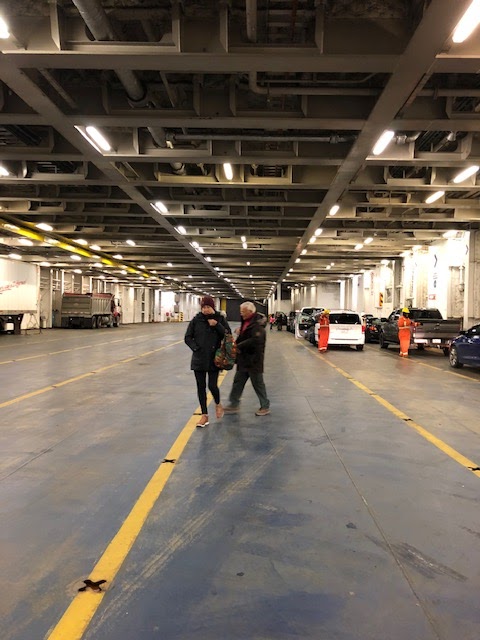
After days of driving through Ontario, Quebec, New Brunswick and Nova Scotia I didn’t give Nordet a thought. It was at Sydney, Nova Scotia, that we boarded the Blue Puttees, a huge ferry, named for the 1st Newfoundland regiment, called the Blue Putteeswhich were decimated during World War I at the Battle of the Somme. We watched for an hour or so, as they loaded semi-trailers onto the ferry and wondered if there would be any room left for cars, but eventually we were waved aboard. We parked on deck three. I think the trucks were mostly on other decks. It turns out that the ferry has over 1 3/4 miles of parking. A few trucks were also on deck three with us.
We were instructed to take everything we needed with us as the vehicle decks were locked while underway. Huge chains hung down from the walls, waiting to chain down the vehicles…an ominous sign if you think about it.
Deck seven had a lovely dining room where nice dinners were served. Deck eight had berths, popular with people doing a night crossing, as well as a seating area. Our seats were on deck nine. Comfort all the way for us, with reclining chairs with a view out of the large windows. We left Nova Scotia at 11:45 AM and arrived at Channel Port aux Basques about 6:30 that evening. It was a pleasant journey.
While there are a goodly number of roads in Newfoundland, only one, the Trans Canada Highway, goes all the way from Port aux Basques to the provincial capitol, St. Johns, on the other side. Generally, the road is shaped like the letter C, tipped over onto its open side. You get off the ship at one end of the C and travel mostly around the C, getting off a bit before the other end. We liked the Newfie landscapes. The first part reminded us so much of the area around Glennallen, Alaska. The northern part of the route resembled the Kenai Peninsula and the final side was very much like the Denali Highway.
We soon discovered Newfie food. French fries drenched with gravy, hash browns and potato chips were served at every meal. At grocery stores it was not unusual to see people with cart loads of potato chips.* Of course, there was also abundant seafood…chowders, fish cakes, lobsters, salmon and others. Hearty breakfasts everywhere always included a choice of breakfast meats…ham, sausage, bacon or bologna.
Our last stop was at the little fishing village of Fortune. Our hotel was beautiful inside with hardwood floors and a bed so tall that they provided a stool to help me get into bed. The hotel had only eight rooms and no on site manager, so once they showed us to our room, they left us to our own devices. As it turned out, because it was the end of the season, we were the only customers there that night. We had the entire place to ourselves. At 10 PM, figuring that no other guests would be coming that night, I went out and locked the exterior doors. I might add that the exterior of the Fortune Hotel did not match the luxury features of the interior. It looked like a double wide trailer had been hauled onto the lot and skirted. In fact, we both felt a bit off center when walking around inside…as if maybe the hotel was not quite level.
The next morning when we awoke, there was a stiff breeze, but the Fortune Harbor was well protected from the elements. Since we didn’t have to catch our ferry to Saint Pierre et Miquelon until 4:30 that afternoon, we had a leisurely lunch at Doc’s Diner.
Roger had delicious lasagna and I had their homemade chili. We still had time to spare, so we went for a ride along the coast where we saw a sign that said, “Al Capone was here.” Apparently during prohibition times, this was a hot spot for transporting liquor to smuggle into the US.
At last it was time to go to the ferry terminal. Since we were going to France, we had to have our passports with us. I felt calm and at peace as we waited for the ferry to dock from the other side. Many of the folks waiting to board were native French speakers. One couple, of Basque heritage had their Labrador dog with them. A French family with three small children and two strollers was also waiting. Life was good.
And then I saw her. Nordet. She was not at all like the Blue Puttees. She looked like half a small, very small, ship. In the front was an area with passenger seats. The back of the ship, meant to hold maybe 15 cars, had only low sides. Sadly, no cars could board the ship. When the French government ordered Nordet and fixed up their dock to accommodate her, they did not talk to the Canadian government about it, so the Canadian side did not match the loading area which made it impossible to load any vehicles onto the ferry.
Then we cast off. The harbor was relatively calm and all was well, but we chewed a couple of ginger-based sea sickness candies just in case it got rough. There was a large flat screen TV bolted to the wall where the crew showed us a movie about where to find life jackets and how to safely evacuate the ship. When we were out in the open sea, the ship began to rock and roll. As long as we were going frontwards through the swells it was doable, but we couldn’t go on that way. Things were getting ominous. Soon we had to change direction to get to Saint Pierre. Now Nordet was running parallel to the swells which tossed us wildly around. The crew members were able to catch the TV as it fell off the wall. The little coffee bar fell apart and bottles of water skittered across the floor. It was hot in there. So very hot. I grabbed the safety instruction card and began to wildly fan myself. I must have caught the eye of one of the crew members, who came over to stand in front of me. “Ere, Madame” he said as he handed me a paper towel doused in ice water, as he indicated I should use it to cool my face. “It will ‘elp.” It did help…but not for long. That fickle Nordet was busy fighting with the waves. Sometimes it seemed like the middle of the ship was trying to go one direction and the ends the opposite way. She came clear up out of the water sometimes and then landed with a thump, but that wasn’t as bad as when she rolled from side to side. The little French kids who were laughing merrily earlier were silent. Sounds of retching surrounded us….and I joined them. That chili was not so tasty the second time around.
One crew member tried to tell us that this was normal weather, but later we heard they had been advised not to take the ferry out that day at all. At last we reached Saint Pierre after an hour and a half of misery and terror. By the time we left Nordet behind we were a bedraggled lot as we walked through the wind and rain.
We were so happy to see the car for l’Auberge Saint Pierre waiting for us there. The driver shepherded us into the hotel as he mentioned that the ferry had been late. Not surprising given the ride we had just endured.
Our bed was soft and inviting. We were safe
at last…..until we remembered that in just two days, we’d have to return to Fortune.
*Note on the potato chips. As we later told our friends in Halifax about the cartloads of chips being sold in Newfoundland grocery stores, they nodded knowingly. “Storm chips”, they said. The weather reports were saying that high winds were predicted as the tail of Hurricane Michael traveled up the coast of Nova Scotia and over to Newfoundland. People were stocking up on foods that didn’t require cooking in case the power went out. Hence “storm chips”.
As it happened, we were to leave Saint Pierre on the Sunday afternoon ferry. I was not looking forward to it. Saturday evening we got a text, telling us the ferry would sail early Sunday morning instead of Sunday afternoon to get it to the mainland and back before the wind became too strong again. If it meant avoiding another ride like we had getting there, we were more than happy to be ready early! Fortunately the ride back was much less adventurous.
Saturday, May 19, 2018
How to Clean a Headstone
Since Memorial day will soon be here, I thought this would be some useful information.
Yesterday I had a chance to attend a community preservation workshop. One of the classes demonstrated to us how to properly clean a headstone. Since our family struggled with this some years back, I wanted to write down what I learned for future reference.
1. Headstones should first be cleaned while dry with a soft brush (preferably soft natural bristles).
2. Then soak the stone with water and keep it wet while you work on it with the soft brush. You can use a wooden stick, such as a popsicle stick, to help clean out lichen and such. If more than that is needed you can use a product such as D/2 or Orvus.
3. You should clean the stone when the temperature is above 40F. If it is a hot day, you should let the water warm up before you put it on the hot stone. No cold water on hot stone.
4. Things you should NOT do or use include: bleach, wire brushes, power tools, pressure washers.
5. They don't advise putting sealants on the stone. If you feel you must put something on, make sure it says it is breathable or permeable ...not water proof.
6. Stones should not need to be cleaned oftener than every 5 years.
7. You should not use Portland cement to repair cracks or as mortar. Marble and Limestone are particularly vulnerable to acids. So no acidic products should be used. (Lichen roots are acidic! Who knew?) You want to use only pH neutral things.
8. Unrelated to cleaning, but still good to know: Doing rubbings of headstones is damaging to them and should not be done.
Subscribe to:
Posts (Atom)