Saturday, July 4, 2020

Proud to be an American


Today has been a little bit hard…our country’s birthday.  He loved his country and served for many years, first in Air Force ROTC, then active duty as a Marine in Vietnam, with the Navy Reserve and finally retiring from the Alaska Army National Guard.  He suffered frostbite, broken ribs, camped out at -60F, walked patrols at 120F and was exposed to Agent Orange, He proudly saluted the flag.  This is the first 4th of July he has missed since 1947.


Friday, April 24, 2020

Armistice Day

Another mystery came to light today.  I suppose it will never be solved as the people involved have both passed on.

I came across a handwritten poem today.   The author of the poem is given at the bottom as Kay Freeman, who is my uncle, but the handwriting I believe to be that of Kay's mother, my grandmother, Ruby Kotter Freeman.

Kay was born in 1921, not long after World War I...or The Great War as it was called at that time.   His school years came along well before World War II, so as a young person, World War I was the part of history he would have probably heard a lot about.  His father had returned from France just a couple of years before he was born.   Did he write this poem for school?  Why did his mother copy it?
Does the original even still exist?  We may never know.

I don't know if the spelling mistakes were Kay's or Ruby's.  I don't know how old Kay was when he wrote it. I would imagine him as a school boy.

I have kept the original spelling.

Armistis Day

1.
Armistis day, you will remember
Comes on the 11 of November
This sure was a day of Joy
For every single soldier boy

2.
The whistles blew, the glad bells rang
And every where the people sang
The Boys were coming home at last
And everyone hoped very fast.

3.
But some of the boys were left behind
Their graves somewhere in France you’ll find
Marked with a cross of snowy white
Mid poppies red is a wonderful sight.

4. 
To these brave boys we owe so much
Who saved us from the Germans cluch
And so each year on this glad day
Honor to these boys we pay

Kay Freeman


Saturday, March 14, 2020

The Spanish Influenza and World War I


The Spanish Influenza and World War I - seen through the eyes of the Freeman Family


At this time I have been thinking a lot about my great-grandparents, George Richard Freeman and Euphemia Jane Carter Freeman.  At the time of this writing, our schools and many other events have been canceled during a pandemic....something the Freeman family also experienced a little over a hundred years ago.  It was a time before many modern medical treatments were available.  In addition to living with the Spanish Influenza, they also had to worry about two of their sons who were serving in the military.

They must have been resilient people to carry on in those uncertain times.  May we take courage from their example as we undergo our own uncertain times.

These excerpts were taken from letters written by members of the Freeman family, mostly to one of the sons, Ernest, who was in France at the time and some of his responses to them.


                                                                    Ernest Freeman


25 October 1918 - France
I suppose you will be able to smell the gas in this letter because it is so strong.  It is the kind that makes you want to cry, too.   We are still in quarantine, but hope to be out soon.  - Ern

2 Novembre 1918 - France
We are still in quarantine.  We are all OK here.  Hope the “Spanish Influenza” has passed over your section of the country by now. It seems to be quite deadly over there, in many cases.  I’m glad I didn’t get it. - Ern

5 November 1918 - Brigham City, Utah
 For almost a month past, we have had no school in this part of the county on account of the Flu (Spanish Influenza) It sure has been going some here and is going yet, but so far all is well with the family as far as Flu is concerned.  We haven’t much doing now everything is closed on account of the Flu.  Haven’t been to church for seems to me an age. - Wilford - brother

7 November 1918 -  Camp de Rouge, France
It seems like the “Spanish Influenza” has made quite a complete trip around the world and it isn’t hard to see where it has been.  Needless to say, it was here, but has completely gone now.  Our quarantine for the “Influenza” was lifted last night, after about 5 weeks had passed.  We have learned to stay “home”, now.  Just like chickens, lock them up for a while and they will “hang around.” - Ern

11 November 1918 - Brigham City, Utah
They talk of opening the schools a week from now, all going as it is at the present time.  I hope that you will not get a taste of the flue, although they say it is all over the world.  - George Richard Freeman - father

11 Nov 1918 - Brigham City
Albert Anderson’s step mother is dead…died of the flue.  - EJ Freeman - mother

16 November 1918 - France
A few days ago, my cousin in England wrote  that her husband had just been killed in action. (October 29).  You know her younger brother was also killed a couple of years ago. - Ern

17 November - Brigham City, Utah
I let W. Bott read your letter.  Him and his folks have all had the flue.  Places are still closed  They talk of opening up about 25 November if all goes well.  Earl W. is home on furlough to get his strength normal as the flue leaves them so weak.  We surely had a time here last Monday beginning at 3:50 AM in the Sugar Factory and Cement Plant and fire whistles were blowing for nearly an hour, then Mayor Peters gave a speech at 4:30 AM.  They had a big parade…cars of all kinds, the new truck, and quite a bunch walking with the town band.  It was decided to erect a monument west of the Court House in honor of the boys of Box Elder Co.  - George Richard Freeman - father

17 November 1918 - Brigham City, Utah
This being Sunday and all church gatherings prohibited on account of the influenza, I thought I could spend my time no better than by dropping you a few lines.  It seems very peculiar not to be able to go to a meeting of any kind, but it gives one plenty of time to read the newspapers and keep posted on what you fellows are doing over there.  Last Monday at 4 AM the shriek of the fire siren and the ringing of the fire and Presbyterian bells announced the signing of the armistice.  Immediately the streets were filled with people and a bonfire was built on Main Street where Mayor Peters  explained to the people the terms of the armistice.  As this was too early to have a real celebration, 9:30 was fixed as the hour.  At this time, the people came out and celebrated in grand style.  All business was suspended and everybody declared it was the most glorious day of their lives. - M.L. Nichols - friend


18 November 1918 - Brigham City Utah
The Flu has been and is very bad here.  The schools and public places of all kinds have been closed for 5 weeks at this writing and no hopes for anything to open before December 1st anyway and it certainly has taken toll.  Nobody knows who’s next, but I don’t care for my turn.  We have 4 Docs in town and 3 of them were down at once, leaving the town and surrounding country for 1 Doc and had it not been for Dr. Weymuller getting his discharge from the army about a week or 10 days before they took down, we would have been doctorless.   - Harry F. - brother

23 November 1918 - Camp de Rouge, France
You were wondering if I got the “Spanish Flu.”  Decidedly not.  I haven’t time for such things.  I would be in the best of condition when most of the boys were on their backs.  If you have had the disease there for six weeks, you should be about thru with it by now.  I think you are all out of luck for turkey this year.  It looks like nearly all of the turkeys will be sent over here and the ducks, geese and chickens will be left for you folks. - Ern

24 November 1918 - Brigham City
We started your box (Christmas box) off last Friday.  Hope you will get it ok.  I wish it had been twice the size but we did the best we could with all public places closed and everyone has to wear a mask to go in a store or clerk in one.  It is quite amusing to see people around with a piece of gauze over their mouth and nose, but they have to do something as lots of people are sick and quite a few dying around and some in Brigham.  Sister S. lost her boy last Friday with the flue.  He was about 8 years old.  It is surely a terrible thing.  We have escaped so far but cannot tell who will be the next one.  I hope that it is not so bad in France.  I see by the paper that several of the boys in the band were down with it.  Hope they are all well by this time.  Everybody is glad the 145th are coming home again.  - George Richard Freeman - father

2 December 1918 - Brigham City, Utah
We see an account in the paper about the flue, but among the troops over there and I often thought about you boys.  Today’s paper tells us how to treat it if it should come our way.  It was written by a soldier from Salt Lake who belongs to the 145 F.A. (145th field artillery).  I am very thankful to say we haven’t had it - up to this writing, but it has been very bad in many places.  The people here have to wear masks when they go in any of the stores.  It sure seems funny not to go to Sunday School or meeting for about 6 weeks.  We don’t know what to do with ourselves.  - mother

2 December 1918 - Brigham City
Ida (Ernest’s sister) was up to nurse Leonora R.  She died at 10 0’clock this morning.  She came home to wait upon her father who had the flue.  They are all down with it now.  There is surely lots of sickness this fall.  They talk of opening school on Monday December 9.  It has been closed since October 20.  Quite a long recess.   Everyone is compelled to wear a mask who goes to work in a store or any public place.  It surely looks funny to see people around with their mouth and nose covered up but it is alright if it will do any good.  It’s surely a terrible thing if people are not careful.  We hope and trust that you will not come down with it. - George Richard Freeman- father

9 December 1918 - Brigham City, UT
We are all ok at present for which I am very thankful as there is so much sickness around us all the time.  Sister Kotter had all of them down with the flue, but I think they are getting along ok now, so Henry told me the other day. Will told me that Homer had got it up north.  It seems to be all over now.  There has been over 350,000 die in America since it started.  I am still doing mail as schools are still closed.  They opened churches and places of amusement in Salt Lake this week to see how they could make it, although they have quite a lot of the flue there at present.  People want to know when you are coming home.  We tell them we do not know.  Mrs. North has not heard any news from her boy since July. 
-George Richard Freeman -father


9 December 1918 Brigham City
I did hope you boys would not come back ’til the flue had gone, but we must hope it will be gone by then. It sure has been terrible.  It has took Jerry Shaw, the conductor on the O.L. and I.  I have a good time nowadays.  School has been shut up for the last 8 weeks and it don’t look like they will open this side of Christmas.  Meetings, pictures shows and everything is shut up on account of the flue.  We have to stay home nowadays so I am making plum puddings and mince pies ready by the time you get here.  Ida has been  very busy in Salt Lake with the flue patients.  She was here in Brigham looking after Leona Reeder.  It is Dave Reeder’s daughter, but she died so Ida went back to Salt Lake.  Leona was a nurse like Ida…took her training at the LDS.  Leona took care of Joseph F. Smith.  After he died she came home to Brigham to take care of her father with the flue and she took it and died. - mother

12 December- Camp de Genicart, France
We are not rushed with work because we are now in quarantine and the weather is very wet, with plenty of mud to go with it. - Ern

15 December 1918 - Brigham City, Utah
I have started a fire at the school today.  They expect to open this coming week.  It has now been two months since we quit.  It is surely a great thing to go around these days when there has been so much sickness, but I think the worst is about over now.  They are sure discharging  (the soldiers) quite fast now.  They want to bring the 145th to Salt Lake before they disband. - Geo. R. Freeman - father

18 December 1918 - Camp de Genicart, France
During the past few days a big fence has been placed around the camp and we have been placed in quarantine.We have also had our physical inspection and there is nothing holding us now, only lack of transportation.  Tomorrow we have an inspection and make our packs, and get ready to go, so I guess we will sure get out in a few days.  This will be my last letter written from France.  - Ern

1 January 1919 - on the ocean
We left Bordeaux the day before Christmas.  You should have seen our happy faces the morning we left.  It hardly seems possible that we are on our way home.  I suppose we will be there in a few weeks. - Ern

7 January 1919 - Camp Merritt, New Jersey
We arrived here after spending about 13 days on the ocean and landed in Hoboken, NJ on January 5. - Ern

We have no date for Ernest's exact return home.

26 March 1919 - Cheyenne, Wyoming
I had to leave home (Brigham City) in a hurry.  I didn’t know about it until just before noon and had to get out on the 3:30 car.  The train traveled very slow, but I got here just before noon and went right up to the fort where I got to see Bert (Ern’s brother who was in the army at Ft. Russell).  He looks quite sick and he is very sick.  He has pneumonia, an after-development of the “Flu” but he is much better now than he was a day or two ago, so he must have been ‘some sick’.  He is getting pretty good treatment and at present they are trying to break up his cold.  There is nothing I can do, only go and see him, and they will only let me stay about 30 minutes.  I can see him twice a day. I think he will be out of bed in a few days, or probably a week. - Ern

27 March 1919 - Fort Russell, Wyoming
Today Bert took somewhat of a back set and he isn’t in as good condition today as yesterday.  However, he has a good fighting chance.  His heart is very good and his fever not high, but his pulse is a little high and his lungs are affected.   I don’t know when I shall come back, but I cannot come for some time. - Ern

                                                  James Bert Wallinger Freeman   "Bert"


28 March 1919 - Fort Russell, Wyoming
Bert died today.  Ern  (Ernest accompanied Bert’s body back home to his family in Brigham City.  When the family got the telegram about Bert’s illness, they chose Ernest to go be with Bert.)


Saturday, December 14, 2019

Roma Freeman - World War II - The Homefront

--as told by Roma

    When I was a senior in High School, my father was called up to active duty and sent to San Luis Obispo. He had problems with his ears as a result of his service in the artillery in World War I.  Because of this, he was eventually given a medical discharge. He got home from being discharged the day of my graduation from high school in 1941. He got into Ogden by train in the afternoon, so we went down and picked him up
    After graduation I worked in the summer at a cannery peeling tomatoes. I was determined to go through college, so I wanted to earn some money for that. We peeled dishpans of tomatoes for 8¢ a pan.  It bothered my hands, so I had to wear rubber gloves. We’d walk about a mile and a half each day to the cannery.
   Later in the war I worked at the cannery as a timekeeper. Each day a busload of POWs was brought to the cannery to work.  They were from the POW camp in Tremonton. I had to keep track of them. Since my office was closest to the working area, I caught most of the First Aid problems. I remember that one of the POWs cut his hand one day and had to be taken to Bushnell Hospital to have it stitched. 
   One of the POWs painted a picture of me, but I couldn’t really pay him for it as money wasn’t allowed in the camp, so I could only pay him 2 packs of cigarettes.  Most of the  POWs didn’t speak English, but the guard spoke a little German I think. He usually left his gun I’m my office during the day. After the war they were all sent home.


   I was a freshman in college when the war started. We were in church on Sunday, December 7th, but as soon as church was over the news spread like wildfire!  Pearl Harbor had been attacked.  After my freshman year, I worked as a messenger at Bushnell Hospital while they were building it. Bushnell General Military Hospital was an Army World War II hospital in Brigham City, Utah from August 1942 to June 1946. It specialized in treating amputations, maxillofacial surgery, neuropsychiatric conditions, and tropical diseases. It was also one of the first hospitals to experimentally use penicillin. Bushnell was a regional facility for wounded solders from the Mountain States that provided quality medical care to patients.
   Another summer I had a job at Hill Field near Ogden.  I carpooled with several other workers, including my brother Kay who could not join the military for health reasons, and also my cousin, Wayne Freeman who was also exempt for health reasons.  The people who worked at home also helped the war effort.  My job at Hill Field involved keeping track of planes that were out of commission and finding where the parts where so they could be repaired and sent back into service.
   Rationing soon became necessary because of the amount of goods needed for the war effort.  That was a problem for my parents as they had quite a few fruit trees and depended on canning those things for food.  They had to apply for extra sugar rations during the canning season in order to be permitted to buy the required sugar.
   Gas was also rationed which meant no traveling for pleasure.  Once a friend was able to get a motorcycle, but it was in Salt Lake City, so he was given an extra ration of three or four gallons of gas so he could go get it.  Even though Logan was not that far from Brigham City, we couldn’t get enough gas to go back and forth much, so  stayed in Logan the whole time except for summer vacation when I went home to work.
   My older brother, Dean, was in ROTC at USAC.  When he graduated in the spring of 1942 he was not able to wear the traditional cap and gown.  He graduated in his military uniform and was commissioned a second lieutenant as well as a call to active duty. He also got married in September of 1942.
   Dean  received his overseas orders in 1943 and was sent to England.  We had maps of the various areas where people were stationed, so we had a rough idea of where he might be, but we couldn’t know for certain because of censorship.  He participated in Exercise Tiger. We later found out that he was part of the D-Day invasion,  landing on “Utah Beach.”  While Dean was away, his first child was born in December 1945 at Bushnell Hospital.  He didn’t see  his son until  he was almost 2 years old. At home, we couldn’t be sure just where he was, but we suspected where he was and listened to the news of the war as well as following the progress of the Allies on a map.
   At school (Utah State Agricultural College)  I started on the Smith-Hughes program which was vocational home economics to train teachers. It entailed me taking 18-20 credits per semester. It was during school that I first met a young man named Verlin Stephens. After the first 2 years of college, Verlin left for the Army.  I finished my last two years while he was gone. We had dated about 18 months before he had to leave. We got engaged on February 25, 1943.
   When Verlin left for Fort Douglas, I planned to go see him the next weekend, but he was already gone by then and didn’t know just where he was going.


   We saw very little of each other from 1943-1946.  I taught school during the 1945-6 school year at Plain City.  I was hired to teach Home Economics. I taught 7th, 8th, 9th and 10th grades.  There were 3 Home Ec classes as well as a 7th grade Physical Education class. On the noon hours I coached an adagio dance team.
   I went home one weekend after the end of the war and happened to read in the newspaper that the troop ship Olmstead was scheduled to dock that day in Oakland. I knew Verlin had ridden it from Guam to Saipan, so assumed that he would be on it, so I went back home early, assuming that he would call.  I was home only a short time before I got my call.
   Once Verlin was home, we planned to get married in August 1946,  but housing was really scarce just after the war.  The only decent place we could find was available in June.  If we wanted it, we would have to pay two months rent just to hold it, so we decided to go ahead and get married in June.

Friday, November 22, 2019

November 22, 1963--a memory from 56 years ago


 When I left home for Arlington High School on Friday, November 22, 1963, it didn’t seem an extraordinary day.  School went normally until afternoon when I was in Reading Lab.  This was a required nine-week course for Freshmen, to help us increase our reading speed.  I didn’t mind the class, because we got to spend most of our time reading library books of our choice in special reading carrels where a light shined on the lines of the book at increasingly rapid speeds to force us to speed up.
   I was deeply engrossed in a good book when the school PA system came on.  This was unusual since most announcements were made during homeroom before third period.  After a short burst of static, the principal usually came on to give us whatever announcement he had, but this time, nothing came on except screaming and sounds of hysteria.  We couldn’t figure out what was going on.  The teacher was as confused as we were.  Several minutes later, an intelligible voice at last rose above the uproar and said, “President Kennedy has been shot”.
   In disbelief, we listened hopefully for word that his injuries were being successfully treated.  Schoolwork was forgotten for the day as we sat in stunned silence.  Later it was confirmed that he was dead. 
   On the day of his funeral, school was cancelled so we could stay home and watch the events of the day on television.  What a solemn occasion it seemed.  In many ways, he was such an idealistic president, and when he died so tragically and suddenly, it seemed like part of the American dream died with him….or, perhaps it was just the rose-colored glasses of my childhood being cast aside.


Tuesday, November 19, 2019

Verlin Clark Stephens - WW II


Verlin Clark Stephens - WW II

Pearl Harbor

   World War II began in the fall of 1939.  I was then 16 years old and felt that it would be over soon enough for me to avoid it because of my age.  By the time the US entered the conflict, I was 18 years old and of prime age for military duty.  The day of the attack on Pearl Harbor, I was washing dishes in the Utah State Agricultural College (USAC) cafeteria and kept hearing bits and pieces of news all day.
   The next summer jobs were plentiful and I got a job at the Quartermaster depot in Ogden. After a month there I got a chance to get a better job as a lookout for the Forest Service. However, the only way I could quit the QM job was with a doctor’s certificate which I got easily because I had lost my voice due to an allergy or infection.
   The year 1942-43 was a very important one for me.  When I returned to school it appeared evident that being drafted very soon was a very real possibility.  However, we were told that we could join the reserves and remain in school until we were really needed or graduated, so I signed up for the Naval Reserve in November.  In December, doctors from the various services came to give physical exams.  Shortly thereafter I was informed that I had failed the Navy exam due to a heart murmur.
   In April they decided the time had come to need the reserves, so they were all called to active duty—except me.  I got notice to go to Bushnell Army Hospital (in Brigham City) for another physical.  I guess I passed because I soon received a notice to prepare for a call by the Army.  I rushed around finishing school early so I would be ready  When school finished I still expected to be called up anytime and was very reluctant to take a job, so I stayed at school doing odds and ends.

Reporting for duty

   Finally I was ordered to active duty on July 16, 1943, at Fort Douglas. I was there for a few days. I didn’t know where I was going, but I thought it would be Fort Old, California, since that is where the other reserves had gone. Three days later we arrived at North Camp Hood, Texas.  It was 116ºF and the camp consisted of black tar paper covered buildings.  The buildings were all new. Our training field had corn stalks in it from the previous years’ crop. The water supply had just been condemned, so what water we used came from lister bags hanging in the sun and containing a generous portion of iodide.  When we were finally assigned to a company for training, our new commander made a bit hit by providing our lister bag with a chunk of ice.
 
Training

   I won’t go into details of basic training since it didn’t markedly effect subsequent events. Everyone in the unit was scheduled to go back to school under the Army Specialized Training Program (ASTP).  Somewhere along the line we were again given more tests and then an interview. I was told that I had qualified for the Junior year of engineering and could take my choice of electrical, civil or mechanical.  Also we were asked three states where we would want to go to school. I asked for Utah, Idaho or Colorado, and since I had no previous engineering, it was agreed (I thought) that I would be assigned to a one term review course.  When the time came to leave, we were all going to be separated and sent to the schools we had requested. We went almost straight north out of Texas, through Arkansas and the eastern edge of Kansas, and continued north finally into Canada, then southeast to our destination—New York City, which was far from the states I selected.  We were all assigned to Pratt Institute and lived in a public housing project near the Brooklyn Navy Yard.  My roommate was a young fellow named Burt Schultz and he was from New York City.  At the first opportunity we went to see his mother. She lived in a large apartment on Central Park West. I soon learned how the other half lived.  Burt’s father was vice president and general manager of Raytheon Corp., and in my eyes, they were rich. During World War II, Raytheon employees contributed to the war effort. They supplied 80 percent of the magnetron tubes used in U.S. and British radars and developed parts for the crucial proximity fuse in antiaircraft shells, among other equipment. Raytheon met urgent production needs for magnetron tubes used by Allied forces for radar defense, and produced the Sea Going (SG) microwave surface search radar that went on U.S. Navy ships. The SG provided vital situational awareness in the major battles in the Pacific and helped eliminate the submarine menace in the Battle of the Atlantic.
   The other good friend I made there was Harold Rasmussen. Harold was from Westfield, New Jersey. After he took me to his home for a weekend, I almost became a member of his family.  For the next two years I spent my weekends there whenever possible. They, too, were fairly wealthy by my standards, since Mrs. Rasmussen’s father had invented the disposable paper cup, and a holder for them. He had then established a company to make them. It had gradually expanded to make napkins, place mats, wall plaques, etc.
   As I mentioned, being assigned to advanced engineering turned out to be important for me. After one term, the ASTP program was closed and all those in the first two years and the review course were sent to the 86th Infantry Division on maneuvers in Louisiana.  The 86th was sent to Europe  and into combat on December 24th, 1944 during the Battle of the Bulge. A very large portion were killed in the first few hours. My friend, Harold Rasmussen, was wounded. He recovered and returned to combat for a few hours, only to be shot again—through the forearm. He lost most of the use of his wrist and was discharged but eventually recovered completely.

Signal Corps

   Those of us in electrical engineering were assigned to the Signal Corps. We went off to Camp Wood, New Jersey,  and were eventually assigned to school at Fort Monmouth which was only a few miles from Camp Wood. I requested to be in teletype repair school. This was about a three month course, but one could proceed faster. I think I finished school in about half the prescribed time and then became an instructor until the time came to return to Camp Wood.  Soon I was transferred to a signal company which was preparing to go overseas. As more or less a final fling, we were given a two week furlough and so I went home to Utah for the first time in 16 months.
   I had received a seven day furlough in New York, but it wasn’t long enough to go home, since the only practical means of travel was by train, and that took three days each way at best. I spent that time sightseeing and Christmas shopping. It was a very lonesome period, knowing that theoretically at least, I could have gone home.
   When I returned from furlough, I learned that plans had changed, and of five signal companies, only two were to remain.  Surprisingly, all of the teletype repairmen were left, so there were about 21 in our company when there was only need for seven.  All excess people  were transferred to the infantry.  To fill time, I was serving as the company clerk. We were stationed at Camp Edison, which was another small station a few miles south of Fort Monmouth.
   Meanwhile I continued to go to Westfield, New Jersey, for every available weekend, and the Rasmussen’s always insisted that I bring a friend.  There were several of us who enjoyed their love and friendship.
   As mail clerk it was my official duty to pick up orders for our unit each day. One day the orders were to send about 180 men to such and such infantry unit, (there were about 220 in our company at the time), so I felt certain that I would go, but surprisingly they sent nearly everyone but the teletype repairmen.
   Sometime later we all received orders to go to Philadelphia, to a place called Hog Island, and then to a course in radio teletype repair at the Brookline Country Club just west of Philadelphia.  We were returned to Hog Island.  Again we were promised an overseas assignment and sent home on furlough. When we returned, we were told that the plans had changed and most of the group was sent to an unknown destination. There were four remaining, and we were sent back to Camp Wood “to keep their teletypes in repair”.  Mostly we played pool.  We were housed with a company of Japanese interpreters.  One of the fellows decided he knew a way to find out our eventual destination by going to camp headquarters and asking to change his will.  He came back with the information that we were all going to Camp Beale, California, which was a replacement depot for the Pacific area.  Two days later, he left for Camp Beale..alone.  A few days later we were sent to Vint Hill Farms, Virginia, and rejoined most of the people who had left earlier. We found that the past year had been spent in getting top secret clearances and we were to be trained as code machine repairmen.
   After the school. we received furlough home in preparation to go overseas. By then the war in Europe was over, and while we were waiting for assignment, Japan surrendered. Small groups were sent out to various areas to work, and as each group left, they bragged that they would be released long before those who remained. One group was sent to the Far East. About two or three weeks later, we went to the airport at Agana, Guam, and welcomed them to the Pacific area.  They were sent to Seattle and put on a boat.  We left about a week later and had gone to San Francisco by train, then to Hawaii for four days, then to Guam by plane. 

Guam

   We left Hamilton Field about 10 PM on the night of September 2, 1945, which was the day the Japanese war was officially ended. It was my first plane ride in a ‘big’ plane called a C47. It was a new plane going to pick up wounded, so it had no seats. When it became light the next morning, one of the fellows became concerned that one of the wings seemed to be flapping. We assured him that it was normal (of course we really didn’t know any more than he did). We landed at Hickam Field without difficulty. The next day we rode by the airfield and saw that they had removed that particular wing from the plane. We decided that we had been very fortunate.  From Hawaii we flew to Johnson Island, then to Kwajalein and finally to Guam.
   Since the war was over, we never did do any code machine work. We did transfer a large amount of equipment, which had been dropped in a field during the battles to retake Guam, to a warehouse. I would guess most of it is still there.


Going Home

   Early in 1946 we left Guam on a transport ship, the Olmstead, and transferred to Saipan to begin the process of returning to civilian life. The camp on Saipan was on the opposite side of the island from the port. It took about four hours to go through the required processing. Then we waited and waited. There were frequent rumors of ships arriving to get us. Finally after about four days we loaded back into trucks and recrossed the island to find the Olmstead waiting for us. It was a Kaiser built ship and not really luxury. There were 2500 men on board. We slept in the cargo holds on canvas stretched on metal frames. As I remember, each bunk was about 24 inches wide and perhaps six feet long with about 15-18 inches to the bunk above. There were big garbage cans for those who became seasick. Not surprisingly, we spent as much time as possible on deck.
  Before I left for the Army, I had only tasted olives a few times and didn’t like them, but I acquired a real liking for them in the service. When we were getting ready to leave Guam, two of us ate a whole can to keep from throwing them away. A few hours later we were bouncing up and down with very heavy seas.  The propellers were coming clear out of the water when we pitched forward. Then they announced that dinner was ready. Most of the fellows I was with had long since lost their appetite, but I was hungry. By the time I got there, the line into the galley was long. As we moved up slowly, we passed a fellow who was so sick that he had vomited all over the deck and was sitting in it.  I lost some of my hunger but went on and finally reached the galley.  Food was served in trays and one stood at a table about waist high to eat.  As the ship rolled, some food spilled, and a few people added to it so that the deck was slippery and we slid back and forth as we tried to eat. I soon found what it was like to be seasick. I lost my acquired taste for olives and have never regained it.
   After two weeks at sea, we landed at Oakland, California, and in less than a day we were on our way to Utah on a troop train. Thank goodness that was my only experience on a troop train, a box car with bunks similar to the ship.  There was no air conditioning in those days and we had sailed across the Pacific in tropical weather. The train wasn’t really heated and we finally arrived in Salt Lake City in a snowstorm with the temperature near zero. After a day or so of processing, during which they tried to get us to reenlist, we were released from the Army.
   When I went into the Army, the first month or so I got $21 per month plus board and room and clothing. After that, congress raised the pay for a private to $50 per month, and when I was promoted to Private First Class, I got a raise to $55 a month.  Eventually I became a T/5 and got $66 per month for the rest of my time in the Army. 
   In those days there were no credit cards and very few checks. We were always paid in cash and there were no deductions for Social Security or income taxes. In the Army there was an officer assigned as pay officer. We had to step in front of him, salute, and he would count out our pay. We could have an allotment sent home.

Elverda Thiesfeld Lincoln - WWII - Women Also Served


Elverda Thiesfeld Lincoln - WWII - Women Also Served

Pearl Harbor

    I was eighteen years old when Pearl Harbor was bombed. Most people, including myself, didn’t know where Pearl Harbor was located. I was in the living room of our home, listening to the radio, when I heard the news that day…December 7, 1941. I was shocked and angry.  The following day, many young men, from all over the country, stormed the recruiting offices to join the military services.
    It wasn’t too long after Pearl Harbor that Pa and I left our Minnesota home to go to Washington where he had a job as a carpenter.  Ma and the rest of the family followed not long afterward.
   When the war started in 1941 until 1943, life in our family was changed in many ways. Rationing was one of the changes that took place then.  Gas, sugar, fats and some canned goods all were rationed. The war effort heightened everyone’s resourcefulness. Since there were so many children in our family we didn’t feel like rationing was a big deal. In fact, sometimes we had more of these items during the war than we did before or after. Each member of our family had their own ration book.
   Many men and women joined the services. Evidence of this was the existence of a plain blue small flag hung in windows of families who had sent a daughter or son off to war. A blue star was positioned on this flag for each member that had responded to their patriotic call.  Some were replaced with gold stars, representing a father or son who had been killed.
   Price controls affected everyone’s lives, especially in grocery stores. This was down to prevent price gouging. There was an expiration date on rationing stamps to prevent hoarding. Most stores willingly complied.
   Because of rationing, households were forced to use margarine due to the shortage of butter. It was white and looked like lard. Inside this bag was a large yellow pill that had to be broken and then kneaded into the white. When thoroughly mixed, it looked like butter, but was not as tasty. The reason for this chore was the farmer’s rebelled if the factory-made margarine made it look like butter and they feared the sales of real butter would hurt them financially. In a few years, the farmers quit complaining and now margarine is colored yellow and looks like real butter.
   I also remember hearing and reading about labor shortages resulting from the military’s demand for men, that left women to become not only riveters, but welders, mechanics, crane operators, truck drivers, gas station attendants, and bus drivers. At the same time, women continued to cook, clean, shop and care for their families.
   Children who could afford it used their allowances to buy defense stamps and war bonds. They also participated in scrap drives to collect aluminum foil, metal and worn out tires. These items were recycled into the war effort.
   I remember gas rationing and heard that this was done to keep people home. Fuel at gas pumps was under severe curtailment. For some people this restriction was difficult, especially young people wanting to drive around on Saturday nights for entertainment. The government imposed a nationwide speed limit of 35 miles an hour. Some people turned to the black market to obtain scarce items which usually meant paying higher prices.
   Due to the scarcity of some food products, “Victory Gardens” were planted in almost everyone’s back yard.  This relieved some of the stress of going without. It was a very successful program.
   On September 19, 1943, at the age of 20, I enlisted in the US Navy as a WAVE.  The initials of WAVES stood for Women Accepted for Voluntary Emergency Service.  Each time I walked past the post office in Yakima, Washington, where I lived, a large sign (about three feet by four feet) had an Uncle Sam pictured on it with his finger pointed at me saying I WANT YOU.  The sign was positioned on a sandwich board almost on the sidewalk.  There was no doubt it could be seen by everyone.  The more I walked around this sign the more I took the message to heart.
   At this time I was working a few days here and a few days there at various jobs and couldn’t stand any of them:  jobs like working in a fruit cannery cutting pears in half, a few days untangling twisted piles of clothes in a laundry, applying for a job as a waitress and never showing up for duty, and mostly being unemployed.

Off to New York


   One day I entered the Navy Recruiting Office and was informed the Navy was looking for girls with secretarial training which I had in high school.  I signed up, passed the physical with flying colors, and before I knew it, was on a troop train to Seattle to join nine other enlistees traveling to Hunter College in the Bronx, New York City.  Years later this same place became the headquarters of the United Nations.
   It took five days to cross the USA on a troop train.  The train was crowded with GIs on the way to the East Coast to report to embarkation points to serve in the European theater.  We girls didn’t have a seat assigned to us.  We spent all our time standing in the hallway, looking out the window or trying to get comfortable in any way we could inside the lavatory area.  This area was large enough that three of us took turns lying on the floor so we could get some sleep. None of us took advantage of any GI’s offer of a seat.  They were a rowdy, flirty bunch and we were scared of them.
   A Navy bus met us at the train station. We were a sleepy, exhausted, bedraggled lot.  An hour’s ride through New York City brought us to our dormitories, which were converted apartment complexes located outside the main gate of the college.
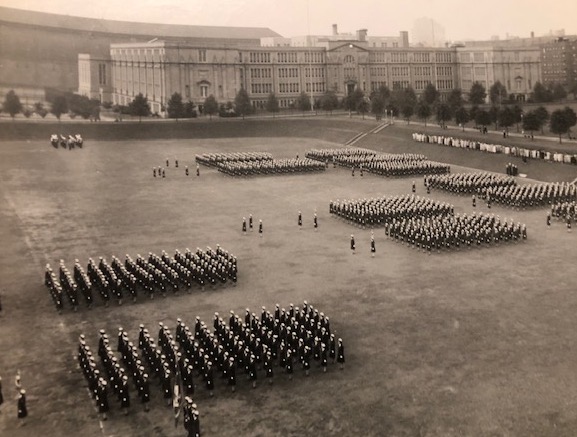
   Our day began at 4:30 in the morning and ended at 9:30 at night.  Boot camp was hard work, but I didn’t mind.  We learned how to march in formation, had classes, took tests to find out what categories we were qualified for, and various other duties as assigned.  Boot camp lasted four weeks.  When I was issued my uniform I felt great. I now was on equal par with all the other girls.  Pay was $50 a month.  My confidence soared.
   Weather in September in New York was hot and humid.  Girls passed out while marching in formation. We just walked over them and continued on. We had ten minutes to eat our meals and be back in formation.
   One day my platoon was last to be served lunch.  Ordinarily food was plentiful, but for some reason the main course ran out. In order to solve this dilemma, trays of meat left over from the night before were reheated and served. About an hour later, recruits were passing out one after another and some were suffering from severe stomach pains. We were herded back to our quarters to recuperate from our ailments. We were sick all night, but the next morning we were back on duty.  we were diagnosed with ptomaine poisoning.
   The afternoon of the last Saturday of boot camp, we were given permission to go downtown.  We were an excited bunch of women, and spent an enjoyable time, visiting Rockefeller Center, Times Square, Empire State Building, St. Patricks Cathedral and the Little Church Around the Corner. We admired the Statue of Liberty from afar, trying not to get lost, and worrying about getting back on time.  Of course, we all had to load up on souvenirs and postcards.
   During that last week we were all herded into an auditorium to attend a musical performance put on by Frank Sinatra. He was so skinny that we couldn’t tell the difference between him and the microphone.  Hours before this program we were given instructions to keep the noise level low-key. In fact, we were not allowed to remove our white gloves, no standing, no hollering, whistling or any other kind of loud exclamation.  This performance was one of the first ones put on by Frank.  Afterward, he disappeared through a back door, was escorted into a limousine by bodyguards, and we quietly returned to our barracks.  Life Magazine published this event, so we knew it was a big deal.


   When boot camp was over (one month later), I was sent to Cedar Falls, Iowa, for a three month crash course in advanced secretarial work which I really enjoyed. I took an aptitude test and passed it with high marks. My three years of typing and shorthand in high school finally paid off.  I met many girls from all parts of the United States, but never became close with any of them.  I was too shy.
   During this schooling, I was anxious to know where I would be serving the remainder of my enlistment. Students could request duty anywhere in the US.  If there was a vacancy they were sent there.  I requested the West Coast.


Back to the West Coast

   My first duty station was downtown Seattle where I was assigned to an aircraft control center. I climbed ladders to put colored pins on a huge wall map so the officers would know the exact location of ships and planes at sea. The radioman of each plane called our office at least every hour giving their exact location. The planes were on constant alert for possible enemy activity.
   Next door to our office was the Russian Embassy. The lone officer on duty came into our office once or twice a week just to look around. He looked impressive in his white uniform. He never stayed long and never spoke to anyone. We used to think he was just lonesome. We never knew if he spoke English or if he gathered any information while strolling through our office. We felt very uncomfortable whenever he was around.
    Less than a year later, I was transferred to Tongue Point Naval Air Station, Astoria, Oregon. By this time the war in the Pacific was going full force. As ships came into port in Astoria, the Navy communications manuals were brought to our office for updating. New coding was inserted, deletions and corrections were made, and old outdated books were replaced by new books.  I clearly remember coding a great number of radio signals in manuals for the Battle of Iwo Jima and the possible invasion of the Aleutian Islands in Alaska. The significance of this coding was not realized until after the Battle of Iwo Jima. Up to this time I was nonchalantly performing my assigned duties, but it really hit me hard when I found out the importance of what I was doing.  I also typed court martial papers for sailors who were not being good boys. No typing errors were allowed on those papers, and if I made a typing error, I had to start over.
   Sailors and ensign officers from the communications  sections of their ships were detailed to our office to help bring coding data up to date, while their ships were in port for repairs or supplies.  The WAVES called these young ensigns 90-day-blunders. They were younger than us and had no experience. The men from these ships were awestruck that women were in the Navy doing work that was vital. Most of the men did not resent the WAVES, but they could not get used to the fact the Navy had women replacing men that were so badly needed at sea. We enjoyed the sailors company and had some good times in spite of the fact it was wartime.
   Looking out the windows of our office, we saw shipload after shipload of lumber leaving the harbor bound for Russia when our own country was so badly in need of lumber for building homes.
   It was common knowledge that unidentified submarines were lurking in the waters off the coast of Oregon. After a few days the submarines disappeared.  It was said every inch of the United States shoreline was mapped and photographed by the Japanese.
   My next duty station was in Portland, Oregon. Our office was a converted scow moored in the Willamette River. Conventional office space in downtown buildings was impossible to rent. Every time a small ship or barge went up or down the river near our scow, we could hear the water in the bilges sloshing to and fro.  This time I worked with teletypes. We sent messages, mostly to shore stations along the coast and to Marine Headquarters in San Francisco.
   The Marine Corps had their recruiting office within walking distance of our office. They used the Navy’s teletype to send messages to their main office in San Francisco. Their runners for this job came to our office every morning to deliver and receive any messages. One of those runners was Bob Lincoln.
   I thoroughly enjoyed my 34 months in the Navy. Now whenever I think about those days, I realize this was a time of great transition in my life.  I was away from home and on my own.  I gained self esteem and confidence and found out what the working world was all about.
   I made many friends. Two of them, Opal from Pennsylvania and Glee from Wisconsin remained friends and kept in contact for many years.
   When the war finally ended, the GIs were welcomed home and they started a new life.  We at home had done everything asked of us to help our men on the fighting front.